KEY POINTS
Issues of Concern • Membership revenue collapse
The JAA has reported a dramatic decline in membership revenue (41 per cent) in its most recent report to the Australian Charities and Not-for-profit Commission. • Surprise loss
The JAA's 2024 Financial Report shows a $21,000 loss, a siginficant change in fortune from its 2023 result of $63,000 profit. • Mixed messages for members
The JAA published a media statement in June 2025 that attempted to pre-emptively dismiss concerns about the loss and the decline in membership revenue. The statement acknowledged the need for an 'accounting adjustment' but did not document which error(s) needed to be amended. • Commitment to transparency tested
The JAA initially responded to requests for clarification concerning the accounting issues; however, it ceased responding to media inquiries after being presented with two simple questions. |
The JAA filed its latest Financial Statement with the Australian Charities and Not-for-profits Commission (ACNC) in June 2025.
This report showed a loss for the year ending 31 December 2024.
There was a dramatic 30 per cent decline in the JAA’s revenue (-$76,631) during this period, falling from $254,627 in 2023 to $156,787 in 2024.
Unfortunately, the bad news didn’t end there, as the JAA attempted to ‘explain away’ the findings of this Financial Statement with a media statement on its website, which, for members, raised more questions than it answered.
Specifically, the media statement says that the -$21,209 deficit was a "loss on paper", implying that there was no 'real' loss for the year.
Beyond the improper use of investment terminology, this explanation is flawed for several reasons.
To say the least, the media statement is confusing, and the JAA's attempts to provide clarity have appeared misleading, or at best, incomplete.
To accrue or not to accrue?
In recent years, the JAA initiated a change in its accounting period. The industry association shifted from a traditional Financial Year (FY) accounting period (1 July through 30 June) to a Calendar Year (CY) accounting period (1 January through 31 December).
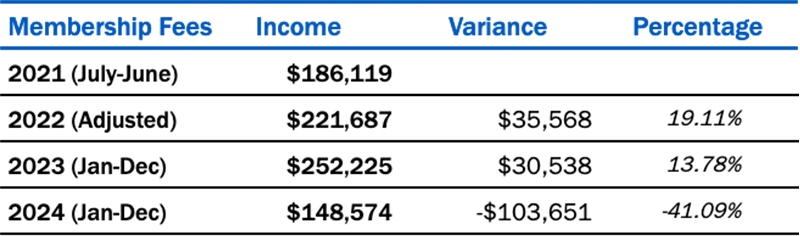 |
MEMBERSHIP REVENUE: This table shows the $103,651 fall in membership fees from 2023 to 2024, which the JAA has attempted to explain as an accounting “adjustment”. Without full explanation, the JAA board also says that the adjustment/error will “now be applied annually”.
(2022 Adjusted - see Editor’s Note).
|
This change occurred during Joshua Sharp’s first year as president, after he assumed the role in October 2022. This means the 2022 Financial Statements, filed with the ACNC, covered 18 months – from 1 July 2021 through 31 December 2022.
At the time, the JAA reported a surplus of $129,791 in 2022; however, it must be noted that this was an unusual reporting period covering 18 months rather than a single year.
The first report under the 12-month Calendar Year reporting structure (2023) revealed that the JAA traded with a $63,063 surplus.
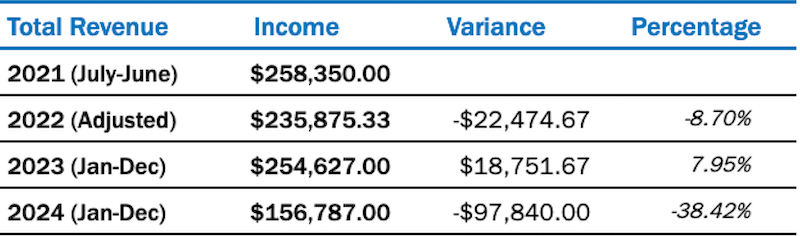 |
TOTAL REVENUE: This table shows the $97.840 fall in income from 2023 to 2024. According to financial records filed with the government regulator, the JAA’s revenue has fallen by 40% since 2021. (2022 Adjusted - see Editor’s Note).
|
The association received $254,627 in income, of which $252,225 came from membership fees, while $2,402 was listed as from 'other' income.
It operated with $191,564 in expenses - $99,808 for staff, while a further $91,756 was simply listed as ‘other’.
‘Other’, in this case, presumably includes expenditures such as bank fees, insurance, advertising, office and computer costs, admin fees, website hosting and so on.
The 2024 financial report shows an annual loss of -$21,209, which represents a dramatic decline (shortfall) of around $84,000 from the previous year's profit.
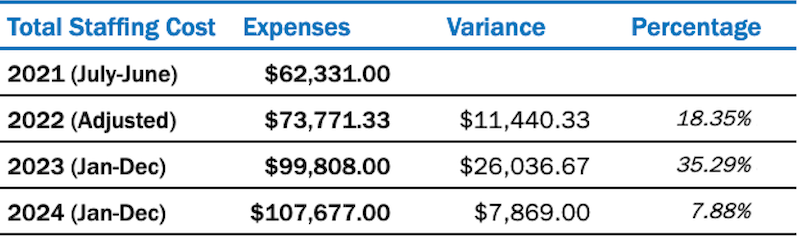 |
» STAFF EXPENSES: This table shows a worrying trend. At the same time as membership income is in decline, JAA staff expenses are increasing. (2022 Adjusted - see Editor’s Note).
|
According to the ACNC website, the JAA's 2024 membership revenues fell by 41 per cent, from $252,225 in 2023 to $148,574 in 2024 - a decline of $103,651 for the year.
At the same time, expenses fell from $191,564 in 2023 to $177,996 in 2024.
By way of comparison, while membership revenue declined by around 40 per cent, expenses only decreased by around 7 per cent (from $191,564 to $177,996).
However, it is worth noting that staffing costs increased by around 8 per cent (from $99,808 to $107,677) in the same period, suggesting that as membership fees decreased, staffing costs rose.
Clarification only adds more confusion
This background information is important to consider because, in June 2025, the JAA sought to explain the annual loss to members with a media statement on its website.
Unfortunately, the explanation for the $21,000 loss during this period raises more questions than it answers.
On 12 June, the JAA posted a statement titled ‘2024 Financial performance update - clarification on accouting (sic) adjustment.’
Firstly, it attempted to imply the loss was not an actual (real) loss and did so by stating that: “The JAA Board implemented an accounting adjustment—now to be applied annually—ensuring that income, such as membership fees received in advance of 1 January, is recognised in the financial year to which it applies.” [Emphasis added]
The JAA claims to practice accrual accounting, which, in the simplest terms, means revenue is recorded when it's earned (not received) and expenses are recorded when they are incurred (not paid).
This fact is confirmed by the JAA's statement: “Specifically, membership fees received in advance of 1 January are now recognised in the financial year to which they relate. This ensures our reporting presents a clearer picture of operational performance.”
This is accrual accounting or Australian Accounting Standard (AAS) AASB 1001.
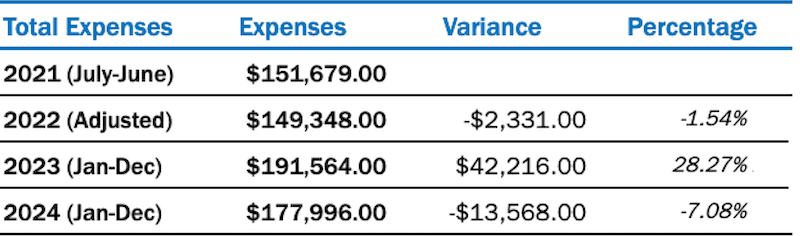 |
» TOTAL EXPENSES: While total expenses have continued to increase while income falls since 2021, the good news is that there was a 7% decline from the 2023 year. (2022 Adjusted - see Editor’s Note).
|
With that said, the JAA’s explanation about its membership income decline and its annual loss is either confusing or misleading.
An ‘accounting adjustment' is a correction, which is made to amend an error(s) or make changes to something for accuracy. That is, an item is ‘adjusted’ if it is not correct.
An accountant does not adjust something that is already correct.
Following that logic, the fact that the JAA needed to make an accounting adjustment therefore means that the previous year’s financial statement (2023) was, in some way, wrong or inaccurate.
It means the 2024 financial report had to be adjusted to correct the previous year’s error.
It appears that, while the JAA had advised the ACNC that its financial reports were prepared in accordance with AASB 1001, it was not.
This can best be explained with the following:
Q: When is accrual accounting not accrual accounting?
A: When it isn't done correctly.
The confusion around this matter is only intensified by the JAA’s decision to advise members that the accounting adjustment will “now be applied annually”.
Compliance with AASB 1001 would mean that no ‘annual’ adjustment would be required, because income and expenses should be accrued correctly in the first place.
If a mistake is corrected one year, there should be no need to continue correcting it every year thereafter because your accrual accounting is accurate.
This is just one example of the JAA’s supposed ‘clarification’ being either misleading or an inaccurate representation of accounting practices.
Speaking out of turn
The statement also explained that, “As a result of this adjustment, the 2024 financials will show a loss on paper. It is important to emphasise that this is not a material or operational loss.” [Emphasis added]
A loss is a loss.
Jeweller spoke with accounting experts as part of the research for this report, and each expressed bewilderment over this phrasing, suggesting that it was either purposefully misleading or ignorant of basic accounting standards.
Further, the JAA attempted to use an inappropriate investment term to explain its annual $21,000 loss.
While 'paper loss' is a legitimate business term, it is used in investing circles to indicate an unrealised loss.
The term applies when an asset's current market price is lower than its purchase price; however, the investor has not yet sold it, so no actual loss has been incurred. The asset's value can rise again; hence, it is only a ‘paper loss’ at a given point in time.
The JAA’s loss is a realised loss, which cannot alter or improve.
Therefore, the JAA's use of the term "loss on paper" is misleading because if the financial result of 2024 is overstated (resulting in a loss), then the previous result of $63,000 profit in 2023 must also be overstated (resulting in a lower profit).
It is also possible that the $129,000 profit reported for 2022 was overstated, given that it covered the 18-month period.
While the JAA’s website ‘clarification’ went to great lengths to imply that the 2024 loss was not a real loss (because of an accounting adjustment/error), a more complete explanation should also have advised members that, as a result, its previous year’s Profit & Loss reports were inaccurate.
In recent years, the JAA has consistently cited an ongoing commitment to transparency. This could be better achieved by the JAA advising its members on the actual figures behind the ‘accounting adjustment.’
Background reading: Director quits over JAA governance issues
Was the JAA's accounting adjustment for, say, $10,000, 20,000 or $50,000?
By publicly announcing the figure and ensuring complete transparency, JAA members and the broader jewellery industry will be better placed to assess the association’s financial position more accurately.
For members, this would also add greater context to ongoing discussions around the JAA’s recent 41 per cent decline in membership revenue.
As part of this research, Jeweller contacted JAA operations manager, Megan Young seeking clarification about the ‘accounting adjustment’ and the media statement, which attempted to explain the matter to members.
An initial response attributed to the ‘JAA Board’ provided a partial explanation about the change from Financial Year to Calendar Year reporting; however, the association ceased responding to questions thereafter.
The JAA could easily clarify the confusion by being further transparent by declaring the dollar figure of the adjustment, but at the time of publication it has not done so.
Not the first time - previous errors and problems
This is not the first time the JAA has found itself in ‘hot water’ over accounting practices and problems. Its FY2017 financial report contained a number of errors and discrepancies.
Not only did it record that 139 members (20 per cent) resigned/quit the association in that year, the JAA’s trading result (loss) was given as four different figures: -$140,014, -$132,819, -$135,819 and -$131,819.
The errors also included the losses being recorded incorrectly in the wrong years.
Following the story, the JAA board admitted the errors - placing blame on its official auditor - and removed the financial statements from its website.
In fact, the following year the JAA appointed a new accounting firm to review its 2018 Financial Statements which were called into question with a significant error being identified in the previous year’s (2017) financial report to members.
In an audit Review Report Jeffrey Tulk, partner at Saward Dawson Chartered Accountants, identified the error, which also contained a ‘qualified opinion’, resulting in a ‘retrospective restatement’ of the 2017 Financial Statements.
When contacted at the time regarding regarding the 'problems' with the JAA accounting, Tulk advised: “You have to ask the [JAA] directors that question. I have explained why I can’t sign off on that as an unmodified opinion within that qualification."
Most recently, Jeweller asked the JAA if its financial reports are still independently audited or reviewed and if accounting and advisory firm Saward Dawson still acts for the association.
No response was provided, and the email was not acknowledged despite being sent to the entirety of the JAA board.
EDITOR'S NOTE
JAA 2022 Financial Report The JAA 2022 financial report covered 18 months. For fair comparison, Jeweller averaged all income and expenses in the four tables above to provide an "Adjusted" result as a guide for a 12-month period. |
More reading
Crushing blow: JAA director confirms shock resignation
JAA’s Correction Request: Rules for thee, but not me
JAA’s confusing statement: Misleading, poor phrasing, or undue credit?
JAA expands board, seventh director appointed
JAA detractors must answer some tough questions
A New Chapter: JAA to exhibit at Australian Jewellery Fair in 2026
 | 2026 JEWELLERS' SUPPLIERS DIRECTORY
Find Anything & Everything Click for the Full Index to discover fresh products, trends, and suppliers.
If it’s not listed here, it’s not worth knowing about! The annual Suppliers Directory is the #1 directory for retailers looking for new products and new suppliers. If you don’t know, we do!
|