The watch industry has always moved in cycles of disruption and stability, propelled forward by innovation while remaining anchored by tradition.
Few industries illustrate this never-ending tension more clearly. Landmark shifts, including the Quartz Revolution, the rise of digital timekeeping, and more recently, the era of smartwatches, have provoked permanent changes in consumer expectations.
At the same time, the enduring appeal of mechanical craftsmanship and heritage-inspired designs continue to ground these products in familiarity and trust.
For Australian jewellery retailers, watch products are an opportunity and a risk. Watches are no longer simple instruments of time; they are fashion statements, status symbols, fitness tools, and, increasingly, extensions of lifestyle. Some of these shifts represent genuine structural changes; others are seasonal swings in taste.
Popular topics of discussions, including colour palettes, case sizes, and dial design, often recede as quickly as they arrive. With that said, it’s always important to be mindful of the tide, lest we get washed away.
As another new year gathers pace, fresh currents are again reshaping the watch market. Watches remain in constant motion, and the challenge for retailers is not just to identify what is new and popular, but also to understand which trends may sustain enduring momentum.
Could the coming year bring about a so-called ‘colour revolution’? Some industry experts certainly feel that may be right around the corner. A shift from safe, monochrome dials to vibrant hues speak to the enduring appeal of individuality and personality in adornments.
Across price points, deeper greens, powder blues, pastels and even bold yellows and reds are emerging as standout choices, not just niche experiments. Brands, from mainstream to luxury, are leaning into expressive shades to differentiate products and appeal to style-driven consumers.
For jewellery store owners, stocking a range of colour-forward pieces may just meet increasing demand from consumers who see watches not just as tools, but as expressive accessories.
“While black and white will likely continue to be the single most popular colours, their overall share of the market is steadily declining as more diverse colours come to the fore on people’s wrists,” writes Michael Sonsino for Oracle Time.
“Tudor’s Blue Flamingo, Rolex’s pistachio Oyster Perpetual, the Seiko 5 Sports x Pink Panther, even the majority of stone dial watches – the most talked about watches from across 2025 have all been bright and colourful.”
“I don’t see any reason for the expansion of colourful dials to slow down in 2026. A lot of watches are already in a handful of options that normally include black, white and blue at a minimum, so it won’t take much for that to start encompassing green, red, pink and other popular colours.”
The report continues by suggesting that for fans of colourful watches, the coming year might be a time of celebration. While the classical black and silver styles won’t vanish overnight, an increasing array of choices is available for both retailers and consumers who prefer variety.
“It’s no surprise, therefore, that while black continues to be the single most popular colour, its overall place in the colour landscape is shifting as a greater diversity of colour comes to the fore,” Sonsino continues.
“The following colours are experiencing a growth in popularity year on year: blue, green, silver, champagne, pink, orange, red. These colours are remaining stable year on year: purple, bronze, yellow, salmon, grey, and mother-of-pearl. These dial colours are seeing a decline year on year: ivory, specialised, brown, diamond, white, black.”
Tools or jewellery?
The wristwatch began first and foremost as a tool. It was a precision instrument that put timekeeping on the wrists during a time when clocks and pocket watches once dominated.
That practical purpose anchored the category for decades: diver watches measured elapsed time at sea, aviator chronographs tracked flight segments, and military-grade timepieces helped coordinate vital operations.
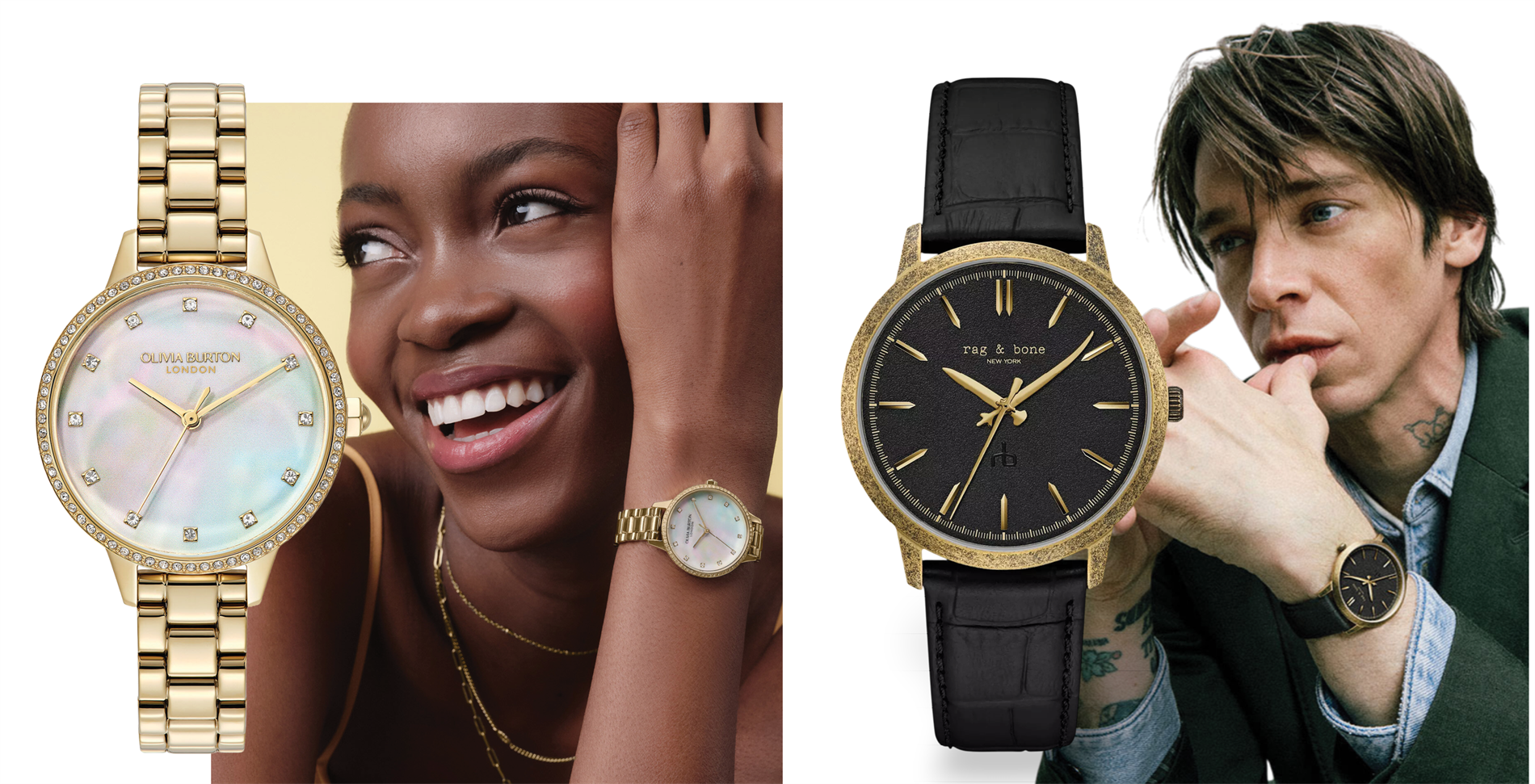 |
| Olivia Burton | Rag & Bone |
As everyday life became less focused on manual timekeeping, as products became increasingly affordable and accurate time became ubiquitous, the need for a watch purely as a tool diminished. Even today, younger consumers increasingly see watches as fashion items or expressions of personality rather than strictly functional devices.
Most people don’t need a watch to tell the time in a world where a smartphone does that job effortlessly; instead, they seek pieces that perform a function, make a fashion statement, or signify status.
“This may be a bold prediction to kick things off with, but 2026 will be the year the watch becomes jewellery. Not in the sense of ostentation – that era is passé – but as an object of refined adornment,” writes Ash Longet of Watchonista.
“Manufacturers are rediscovering gem-setting as horology’s haute couture. Stones are no longer oversized statements but lattices framing diminutive movements. Moreover, the distinction between lab-grown and natural stones continues to vanish.
“For collectors with one eye on wearability and the other on investible rarity, this renaissance of elegance recalls the great Art Deco pieces of the 1930s.
“The connoisseur question we think brands will be answering in 2026 is simple: Why choose between a bracelet and a watch when one can be both?”
This evolution is clear in both product development and consumer behaviour. Traditional mechanical and hybrid watches carry heritage and craft value, while smartwatches and connected wearables speak to lifestyle and convenience — blurring the old divide between technical tool and wearable jewellery.
So long smartwatches?
Recent reports suggest that a significant shift away from smartwatches may be well and truly underway. Luxury brands are reportedly retreating from the smartwatch segment, with most discontinuing updates to pre-existing lines.
High-end companies, including TAG Heuer, Hublot, Montblanc, and Louis Vuitton, entered the wearables market alongside Apple, Samsung, and Garmin. However, as of 2025, only TAG Heuer updated its luxury smartwatch line, according to a report by the New York Times. Oliver R. Müller, founder of Swiss consultancy LuxeConsult, described the luxury smartwatch market as dominated by mass-market players, making it hard for brands to compete.
“The war is over. It’s a niche, loss-generating business with no emotional context and no prospects,” he said.
“The train has left the station, and it’s now out of reach. They remain in perpetual development to meet consumer demand for new technology. The end effect is margins are rarely positive.”
Short product life cycles, high research costs, and low margins are said to severely undermine profitability. According to Müller, smartwatches have significantly affected traditional watchmakers, especially in the entry-level segment.
Swiss watch exports have declined by about half since 2015, with lower-priced watch volumes dropping sharply during the same period.
“The impact was devastating for the Swiss watch industry, because smartwatches were offering usefulness with functionalities that no conventional watch can compete with,” he explained.
Among leading brands, TAG Heuer remains the leading proponent in this category. Antoine Pin, the brand’s former chief executive, described the Connected smartwatch primarily as a customer acquisition tool.
“The Connected reaches clients who might not choose traditional watches. It represents a single-digit percentage of our business, but it helps attract new customers to our stores,” he explained.
Andrew McUtchen, founder of Time+Tide, noted that there is no clear hierarchy or high-status tier within the smartwatch category.
“There’s no such thing as a high-status smartwatch. It’s a democratised object, devoid of hierarchy. It’s a category that struggled to stick, and success is elusive,” he explained.
Time to go
Early concerns that smartwatches would eclipse or erase traditional timepieces appear to have been alleviated. As major brands shift focus back to mechanical craftsmanship and away from wearable technology, it would seem evident that smart devices have found their own lane – fitness, connectivity, and convenience – away from the needs met by traditional watches.
For Australian jewellery retailers, the message remains the same as with every other passing season – the watch category exists in a constant state of recalibration.
Colour is no longer a fringe experiment or seasonal flourish; it has become a commercial opportunity. From deep greens and ice blues to warm champagne and muted pastels, dial variation is driving repeat purchases and appealing to customers who already own an everyday piece. For independents, that creates an opportunity to encourage collection-building rather than one-off transactions.
At the same time, perceptions of watches have evolved significantly. For many consumers, particularly younger buyers, a wristwatch is less about necessity and more about identity. Smartphones have absorbed the functional role of timekeeping. What remains is symbolism - craftsmanship, status, style and sentiment.
In that context, watches increasingly sit alongside fine jewellery rather than electronics. They are worn to express taste, mark milestones, and elevate outfits. Perhaps most telling is the broader industry’s direction.
Heritage, finishing and design narrative are once again the selling points. For bricks-and-mortar jewellers, this signals stability. The future may include technology; however, enduring value lies in products that emphasise artistry, colour and emotion and not just connectivity or practicality.
Read eMag