For modern consumers, there is something particularly appealing about a product that can tell you where it came from.
More specifically, for Australian consumers, that connection appears to be becoming increasingly important.
That was the major finding of an interesting study conducted by Adelaide University earlier this year, which examined evolving attitudes towards locally produced goods. Researchers found that most Australians still have a strong desire to buy local.
Interestingly, the reasons for doing so vary considerably, and perhaps most importantly, not everyone is prepared to pay a premium for the privilege.
The nationally representative study of more than 900 Australian consumers looked beyond the familiar territory of food and examined attitudes towards Australian-made goods across categories including clothing, furniture, decorative items, personal accessories and household products.
Three motivations emerged ahead of the rest. These were supporting the local economy and jobs, a perception of better quality, and a preference for supporting small businesses.
Supporting the local economy and jobs was, by a considerable margin, the strongest motivation across product categories.
For the jewellery industry, studies like these offer interesting insight because Australian colour gemstones provide something that ‘foreign’ or imported products cannot replicate.
Namely, a tangible connection to the landscape from which they came.
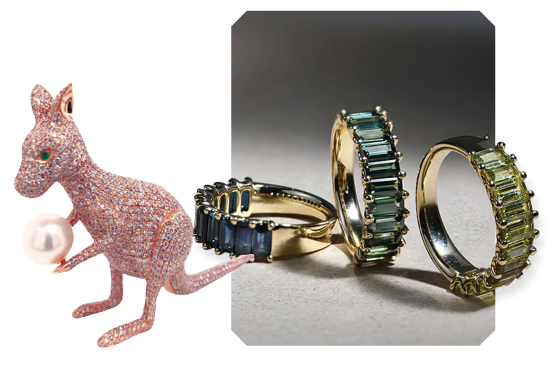
Indeed, sparkling sapphire from the New England fields, enchanting opal from Lightning Ridge, impressive chrysoprase from Western Australia or dazzling topaz from Flinders Island are not merely colourful oddities plucked from the soil.
 |
| Glajz | Sapphire Dreams |
They are connected to a particular geological environment, a mining region, and more often than not, a long history of people scouring the landscape for something rare, beautiful, and valuable. I’m sure you’d agree that’s a story with value at the retail level.
This research also provides an important qualification. A desire to buy Australian does not automatically mean consumers will pay more for Australian products.
Indeed, the study found that willingness to pay a premium was influenced by values beyond income alone.
Older consumers showed the strongest preference for buying local, particularly because they wanted to support local economies and employment; however, they were also the least willing to pay more.
Younger consumers were more likely to cite environmental, labour and workplace considerations and were generally more prepared to pay more for those reasons.
The implication for jewellers from this kind of report is less about adding an arbitrary ‘Australian premium’ to any given product and more about understanding what can make a locally sourced colour gemstone meaningful to an individual customer.
For one consumer, it may be the desire to support Australian miners and small businesses. For another, it could be the provenance and the knowledge that the gemstone came from a particular corner of the country. For another, it may simply be the gemstone's quality, rarity, or visual appeal.
That same study also found key differences in how men and women approached buying locally produced goods. For personal accessories and clothing, women were more likely to cite labour conditions and environmental impacts, while knowing where and how a product was made was also an important consideration.
Once again, Australia’s colour gemstones lend themselves naturally to this conversation. Their origins are physical, their characteristics are geological, and the stories trace to familiar places.
Indeed, Australia's geological map provides an extraordinary range of stories to tell. From the sapphire fields of northern New South Wales and Queensland to South Australia's unique opal country, from Tasmania's colourful lapidary materials to the extraordinary mineral diversity of the Northern Territory, a national gemstone story hides in plain sight.
New South Wales has one of Australia's most deeply established gemstone traditions, and it began almost by accident.
During the gold and tin rushes of the 1850s, miners working alluvial deposits discovered sapphires, zircons, and diamonds mixed among the heavier gravels.
In the early days, some of these diamonds and colour gemstones were simply discarded because their value was not yet understood – if only the miners knew what we know today!
Northern New South Wales subsequently became particularly important for sapphire. The districts around Inverell, Glen Innes, Tingha, and Emmaville produced large quantities of gemstones, especially during the major sapphire-mining periods.
The region's sapphires are notable for their colour diversity. Alongside traditional blue examples, green, yellow, brown and parti-coloured sapphires occur – giving retailers an opportunity to talk about Australian sapphire without restricting the story to the familiar shapes and sights.
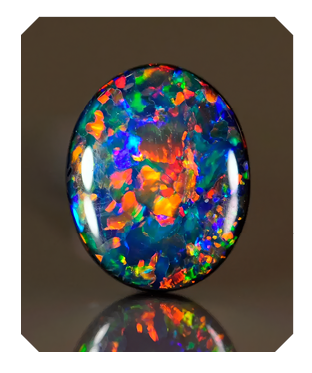
And then, of course, there is opal. White Cliffs, first discovered in 1889, became one of Australia's earliest commercial opal fields, while Lightning Ridge developed an international reputation for its precious black opal. The combination of a dark body tone and vivid play-of-colour makes Lightning Ridge material particularly distinctive.
Remarkably, the region’s geological inventory goes even further – the lucky country, indeed.
Emerald and aquamarine have been recorded around Torrington and Emmaville; chrysoberyl, including occasional cat's-eye material, occurs in several regions; and zircons accompany sapphire in the northern alluvial fields.
For something completely different, Fifield chrysoprase offers vivid apple-green colour, while Broken Hill has produced rhodonite with dramatic black veining, amethyst and garnet.
Much of the state’s gemstone history has been shaped by small operators, family claims, and fossickers rather than giant industrial mines. That gives these materials a particularly strong human story – one that can translate to the retail counter.
 |
| Cody Opal |
Queensland may be famous for sapphire; however, its gemstone story is remarkably broad. Allan F. Wilson's review of the state's gemstone materials records an extraordinary list: sapphire, opal and chrysoprase sit alongside agate, thunder eggs, petrified wood, garnet, topaz, aquamarine, zircon, chrysoberyl, iolite, diamond, peridot, feldspar, scapolite, tourmaline and turquoise.
While it has limited application for a jewellery retailer, perhaps the most intriguing material for storytelling is the thunder egg.
Despite its name, a thunder egg is a volcanic nodule, not an egg. Formed inside gas cavities in ancient rhyolitic lava, the rough exterior can look distinctly unremarkable. Cut one open, however, and it may reveal layers of agate, quartz crystals, chalcedony, and intricate mineral patterns.
These materials demonstrate the breadth of what natural beauty can mean in this landscape. The same principle applies to Queensland's petrified wood, particularly colourful material around Chinchilla, where polished pieces can preserve the cellular structures of prehistoric trees.
At O'Brien's Creek near Mount Surprise, fossickers search old tin workings for topaz, including clear and silvery-white crystals and occasional naturally coloured material. Smoky quartz and aquamarine can also occur.
Marlborough, meanwhile, is renowned for chrysoprase, the translucent apple-green nickel-bearing chalcedony prized in jewellery and carving.
Sapphires and opal are, of course, central to Queensland's identity; however, the state's fields are also places of chance and discovery. That culture of fossicking – and the stories of what might turn up next – adds another layer of personality to Queensland material.
 |
| Autore |
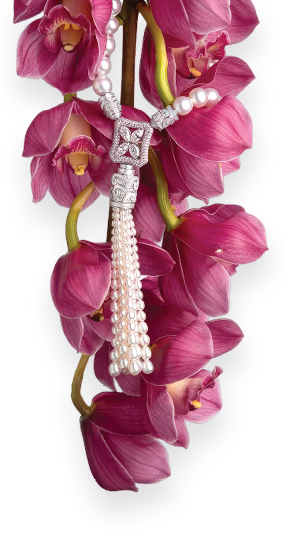
If one Australian gemstone has a natural claim to provenance, it is opal. Opal has been declared both Australia's national gemstone and the state's official gemstone, and its fields have become inseparable from the country's broader identity.
The story begins millions of years ago, as silica-rich groundwater moved through sediments associated with the Great Artesian Basin. As conditions changed, silica accumulated and eventually hardened into opal. At Andamooka, discovered in 1930, miners continue to recover crystal, white and some black opal, and a distinctive material known as ‘Painted Lady’.
Coober Pedy, discovered in 1915, is another of the state's great opal names. Its deposits include light opaque to translucent opal and crystal material, while the local geology can produce remarkable fossilised forms. Opal has even filled spaces left by ancient shells, while rare opalised marine fossils have included plesiosaurs and ichthyosaurs.
Mintabie adds another chapter, although the town has closed and the mine has been decommissioned, with access subject to relevant permissions.
With that said, opal is far from South Australia's only gemstone story. Cowell, on the Eyre Peninsula, has a significant claim. It features one of the world's largest nephrite jade deposits, with green, black and premium black varieties occurring across more than 100 known outcrops.
More than 100 macro- and microdiamonds have been recovered historically, including stones from Echunga and the Springfield Basin. At Eurelia, microdiamonds have been associated directly with kimberlite dykes, although the ultimate source of the state's diamonds remains an exploration question.
Chrysoprase also occurs at Mount Davies, tourmaline at Kangaroo Island, and beryl, corundum, garnet, and zircon also occur. For retailers, South Australia therefore offers an opportunity to start with one of the world's most recognisable gemstone stories and then take the customer somewhere less familiar.
Western Australia's reputation in the broader jewellery trade is dominated by two extraordinary exports: the fancy colour diamonds of the Kimberley region and the pearls of the state's north-west territory.
The significance of these two natural wonders can’t be understated; however, beyond those internationally recognised icons lies a diverse collection of colourful and ornamental materials.
Emerald occurs in numerous small deposits across the Yilgarn, Murchison and Pilbara regions. Other beryl varieties, including yellow, pink and blue beryl, have also been recorded, although faceting-quality material is uncommon.
Quartz provides a much broader source of colour and variety. Rock crystal, citrine, smoky quartz, and amethyst occur in different parts of the state.
 |
| Margot McKinney |
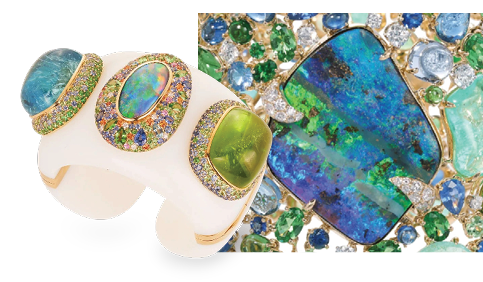
Meanwhile, chalcedony varieties such as agate, carnelian, onyx, and chrysoprase offer material particularly suited to cabochons and other jewellery applications.
Chrysoprase deserves special attention. Western Australian deposits, particularly within the Yilgarn Craton, have produced high-quality material prized for its translucent green colour. The gemstone is hard, takes a high polish and has found international markets, particularly in Asia.
Then there are the unmistakable ornamental stones. Tiger iron from the Hamersley Basin combines bands of brown, red and green with shimmering golden tiger's-eye. Zebra stone from the Lake Argyle area features a contrasting pale matrix and reddish-brown patterning, while mookaite from the Carnarvon Basin offers a remarkable palette ranging from cream and brown to purple.
A newer story is emerging around Laverton, where translucent orange-red common opal, or fire opal, has provided another source of colour.
Finally, Western Australia is a significant producer of variscite, an uncommon yellow-green to blue-green ornamental mineral.
Some WA material contains gold particles, creating a particularly distinctive combination of gemstone and provenance.
For retailers, Western Australia demonstrates that a gemstone need not compete with pink diamonds to be interesting. Its value can lie in colour, pattern, rarity, geology and an unmistakable sense of place.
It goes without saying that Victoria is better known for gold than gemstones; however, the two histories are closely connected.
When gold miners began working the state's rivers and gravels in the 1850s, they often recovered gemstones alongside gold. Sapphires, rubies, and diamonds appeared in the same broad story, though once again, many were initially overlooked or misidentified.
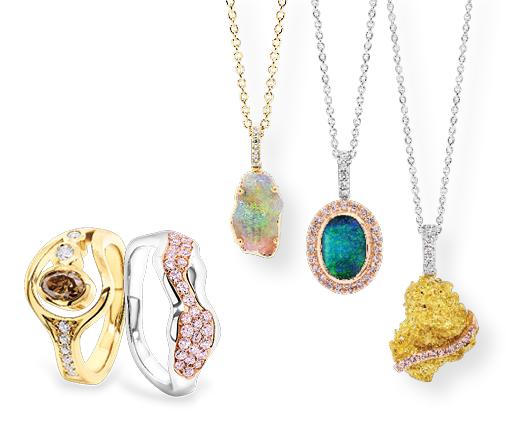 |
| Ellendale Diamonds |
Victoria's diamonds are particularly intriguing. Hundreds are estimated to have been recovered around central Victoria during the gold rush and early twentieth century, with many of the stones yellow. Their original source remains unidentified.
Meanwhile, sapphire is more widespread.
Blue is the dominant colour; however, green, yellow, brown and purple stones have also been recorded. Pink sapphire is considerably rarer.
Most Victorian sapphires are small and water-worn, although larger crystal fragments have been documented. Ruby has been found near locations including Cardinia Creek and Trentham, but it is exceptionally rare. Quartz, meanwhile, is abundant. I remember finding some on a rural property as a child and thinking I had struck it rich!
Amethyst, citrine, smoky quartz, and rock crystal have all been collected across the state.
Perhaps the most spectacular Victorian quartz story is the ‘Crystal King’. A roughly 14.5-kilogram crystal from the Strathbogie Ranges was cut by renowned Australian faceter Alex Amiss, producing an enormous 8,510-carat, 196-facet gem.
Victoria has also yielded topaz, tourmaline, zircon, garnet, peridot and unusual ‘eye agates’.
Despite the variety, most Victorian gemstones never occurred in sufficient quantities to support major commercial mining. That scarcity is part of the story. These are gemstones associated with a historic landscape and, in many cases, with prospecting rather than large-scale production.
Tasmania has no single dominant gemstone equivalent to Queensland sapphire or Lightning Ridge opal. Instead, the attraction lies in diversity.
The state's official mineral emblem, crocoite, is a perfect example. The brilliant red-orange, needle-like crystals found around Dundas on Tasmania's west coast are among the world's finest specimens. Crocoite is too soft for jewellery; however, its collector appeal is enormous.
For jewellers, however, Tasmania's story also includes sapphire, topaz, zircon, beryl, olivine, agate, chalcedony, jasper, quartz, and opalised wood.
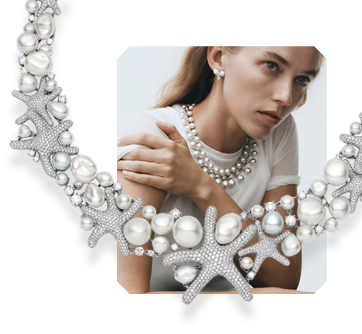 |
| Paspaley |
Topaz is particularly interesting. It occurs in several alluvial tin districts, including Derby, Moorina, Mount Cameron, Weldborough and the Weld River, while Flinders Island's Killiecrankie Bay is famous for clear to pale stones known locally as ‘Killiecrankie diamonds’.
Tasmanian sapphire occurs mainly in the north-east's alluvial tin districts.
Blue, green, yellow and purple stones recorded, along with parti-coloured and occasional star sapphires. One particularly large parti-coloured stone from the Weld River area weighed 52.8 grams.
The state also has abundant lapidary material. Agate and chalcedony are widespread, while Lune River is particularly notable for agate, petrified plant material and distinctive petrified fern.
Polished slices of these materials can produce highly individual jewellery pieces.
Tasmania's appeal, then, is not based on volume, but rather on character. The material reflects a landscape shaped by ancient igneous and metamorphic rocks, younger volcanic activity, and millions of years of weathering. For a customer interested in provenance, that geological connection can be every bit as compelling as a recognisable name.
The Northern Territory may be the most surprising chapter in Australia's colour gemstone story.
At Harts Range, east of Alice Springs, an extraordinary variety of minerals has emerged from pegmatites and metamorphic rocks: zircon, garnet, aquamarine, ruby, chrysoberyl, tourmaline, kyanite, moonstone, and smoky quartz.
In 1985, Darren Arthur and Sonny Mason recovered an unusual gemstone near Kong Bore. Four years later, the Gemological Institute of America (GIA) introduced it to the world as Rainbow Lattice Sunstone.
The material is unique to this small part of the Northern Territory. Its distinctive geometric lattice comes from microscopic inclusions of hematite and magnetite, creating flashes of gold, iridescence, and intricate patterning that change as the stone moves through the light.
Harts Range's story does not end there. The district also produces zircon in colours ranging from colourless and champagne to honey, amber, pink and reddish-brown.
That makes the region a compelling example of provenance. A Rainbow Lattice Sunstone is not simply an unusual gemstone – it has a story traceable to a specific corner of the world.
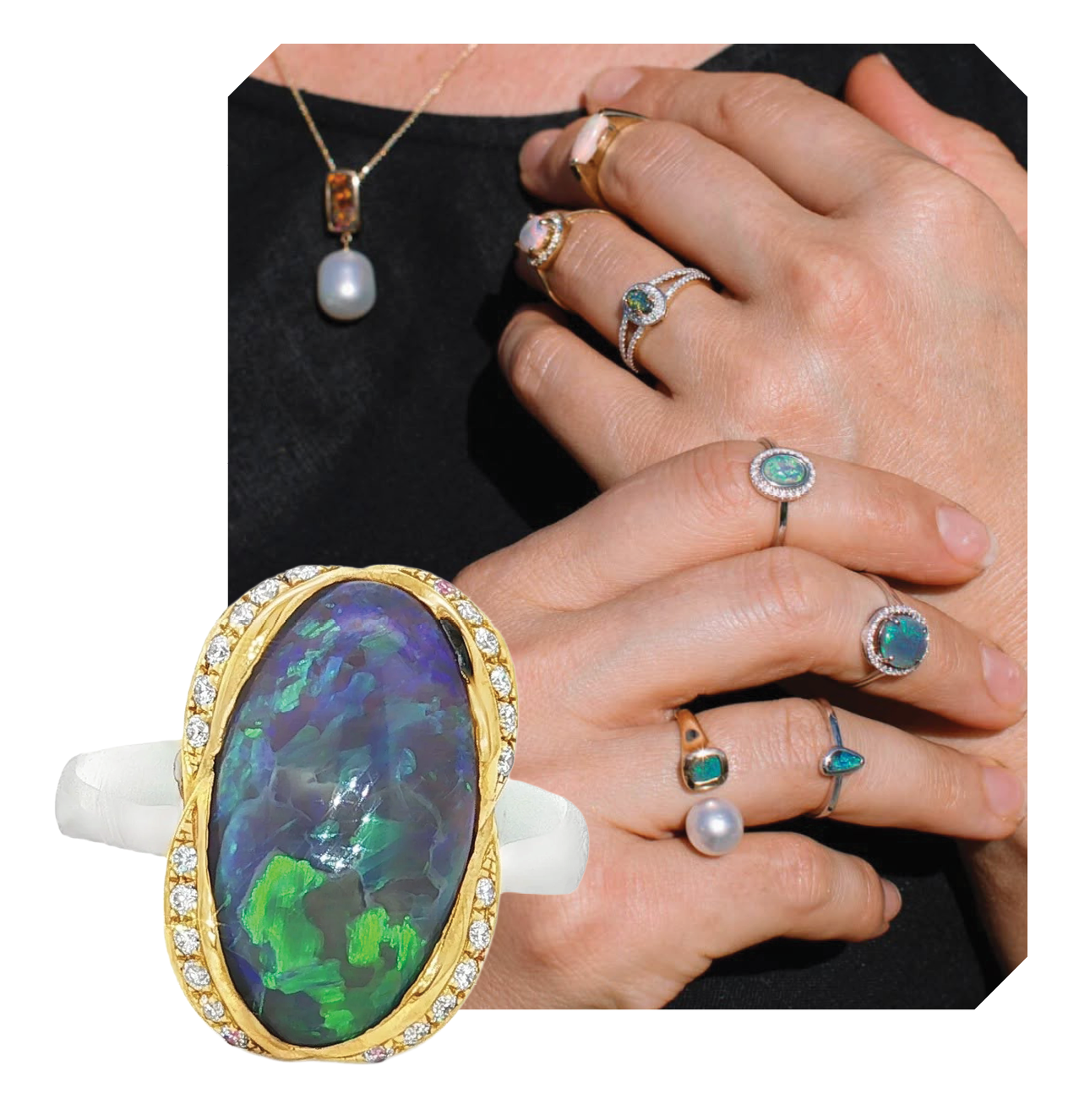 |
| Ikecho Australia |
A national story, one treasure at a time
One would agree that Australia's gemstone map gives retailers an unusually rich collection of stories to work with.
Research does not suggest that every consumer will pay more simply because a product is Australian. Nor does it suggest that every customer is motivated by the same idea of ‘local’.What it does show is that provenance, quality, local economic support and values can all influence purchasing decisions – and that while these motivations vary between consumers, they are all important to your business.
A retailer does not necessarily need to sell a customer on the idea that Australian is automatically better. Instead, provenance can add another layer of value.
Where the gemstone was found, what makes its geology distinctive, who mined or cut it, and why
its colour or characteristics are unusual. These are all stories begging to be told, and the right consumer will listen.
For some customers, the appeal may be supporting Australian industry. For others,
it may be the rarity of a particular locality. Others may simply fall in love with the colour.
In a market where consumers increasingly want to know what they are buying, where it came from, and what makes it different, that sense of place may be one of the most valuable characteristics Australian gemstones have to offer.
Read eMag