CLICK ITEM TO JUMP TO RELEVANT SECTION
» Background: The roots of reform
» Who does this impact?
» Critical Reading & Downloadable Documents
» Risky Business! Understanding Customer Risks with the Rating Matrix
» The Jeweller's Fork in the Road: To opt in, or not to opt in?
» Attention all Jewellers: Minimum requirements for every business
» Structured vs Linked Transactions: Examples for Jewellers
» Final thoughts: Proceed with caution
» Watch Full Seminar
KEY TERMS & DEFINITIONS • Virtual Assets
A digital representation of value that can be transferred, stored, or traded electronically. This category encompasses digital currencies, such as cryptocurrencies, and is subject to AML/CTF oversight to mitigate risks like illicit fund transfers. • Linked Transactions
Transactions that are regarded by AUSTRAC as interconnected or related. Examples include the deliberate splitting of a larger transaction into smaller ones below the $10,000 threshold to evade AML/CTF obligations, or multiple payments that are connected by shared elements such as invoices, payment methods, or dates of sale¹. Identifying linked transactions is crucial for detecting patterns of suspicious activity. • Structured Transactions
The intentional division of a larger transaction into smaller, discrete transactions to circumvent AML/CTF reporting requirements, particularly thresholds like the $10,000 cash transaction limit¹. This practice is a common money laundering technique and triggers enhanced scrutiny under regulatory guidelines. • Soft Opt-Out
A business that has chosen to opt out of being a reporting entity but adopts a formally documented cash-acceptance policy that limits cash receipts per customer and includes monitoring controls to prevent aggregation of linked transactions that would otherwise trigger obligations under the AML/CTF framework. Still required to commit to minimum requirements. • Hard Opt-Out
A business that elects not to be a reporting entity under the AML/CTF Act and therefore refuses to engage in designated services involving cash or other specified forms of value that would trigger reporting obligations. Still required to commit to minimum requirements. |
On 1 July 2026, the Anti-Money Laundering and Counter-Terrorism Financing (AML/CTF) reforms will expand their reach into the jewellery industry, requiring vigilance and strategic decision-making.
These reforms expand upon earlier regulations introduced in 2008 and now include dealers in precious stones and metals, as well as other adjacent products.
In late January, the Australian Transaction Reports and Analysis Centre (AUSTRAC) issued a nationwide communication to jewellery businesses titled ‘New financial crime laws coming – access our newly released kits to prepare.’
This guide, crafted for jewellery business owners, demystifies the changes and offers practical insights to protect your trade from illicit activities while maintaining operational efficiency. It's not just about ticking boxes – it's about fortifying your business against the $60.1 billion annual scourge of financial crime.
Australia's journey towards robust AML/CTF measures began in 2008 with Tranche 1, which targeted high-risk industries such as financial institutions, gambling, bullion dealers, and remittance services.
A 2015 review by the Financial Action Task Force flagged Australia as "partially compliant" with global anti-corruption standards, highlighting gaps that allowed financial crime to drain the economy.
Fast-forward to Tranche 2, effective 1 July 2026, and the net widens: real estate agents, lawyers, conveyancers, accountants, and dealers in precious stones, metals, and products are now in scope.
For jewellers, this means scrutinising transactions to avoid becoming unwitting conduits for money laundering or terrorism financing.
On the 23 January, AUSTRAC sent a Starter Kit email, tailored for jewellers including a document library and steps to customise, implement, maintain, and review your setup.
At its core, the legislation regulates businesses offering "designated services" with ties to Australia. If your operations involve buying or selling precious metals, gemstones, or products for $AUD10,000 or more in cash or virtual assets, you're included.
Precious metals include gold, silver, platinum, and alloys with at least two per cent of these elements. Precious stones encompass gem-quality varieties such as diamonds, opals, and pearls.
Precious products cover jewellery, watches, personal adornments, and goldsmith or silversmith wares – think a gold-and-pearl ring, a diamond-studded stainless-steel watch, or even dental jewellery such as a gold drill.
Businesses that provide one or more “designated services" that have a geographical link to Australia are regulated. Buying or selling precious metal, precious stones, precious products (or any combination of) for $AUD10,000 or more in physical currency or virtual assets.
• Precious Metals: Gold, silver, platinum, iridium, osmium, palladium, rhodium, ruthenium or alloy with at least two per cent weight of any of the aforementioned.
• Precious Stones: Gemstone quality (including but not limited to) beryl, corundum, diamond, garnet, jadeite, jade, opal, pearl or topaz.
• Precious Products: Items made of, containing, or having attached to it any precious metals or stones (or both) that are any of jewellery, watches and other items of personal adornment, along with any article of goldsmith's or silversmith's wares.
Examples include: a ring crafted from gold and pearl, a stainless-steel watch with diamonds set on the face, a headdress made of platinum and garnet, and even a gold or diamond drill (dental jewellery).
Crucially, jewellery business owners must watch for "linked transactions." AUSTRAC views these as attempts to dodge thresholds, such as splitting a large deal into smaller payments under $AUD10,000, or multiple deals tied by the same invoice, payment method, or date. Ignoring these could turn routine sales into compliance nightmares.
Use the table below to classify customers and identify appropriate controls. To assist in determining classifications, consider these risky product areas:
• Unset 9ct to 22ct gold jewellery;
• Certified diamonds 50 points and up;
Watch for these risky customer behaviours, which may indicate heightened risk:
- Customers seeking diamond or gold jewellery for $5,000 or more in cash, and in particular, just under $10,000 in cash;
- Customers buying gold jewellery, diamond jewellery, loose diamonds that do not seem to be particularly concerned about the appearance/quality of the items;
- Customers coming back into the store within a few weeks to repeat the same or similar purchase of gold or diamond jewellery or loose diamonds;
- Customers who ask if you accept cash payments over $10,000
| Risk Rating | Criteria | Customer Risk Factors | Controls |
|---|
| High | • One or more high-risk factors, or
• You identify other reasons the customer is high risk | - $50,000+ physical currency
- Foreign PEPs (Politically Exposed Persons)
- Unexplained wealth or unusual requests
- Scrap metal dealers
| - |
| Medium | • Two or more medium-risk factors, or
• You identify other reasons the customer is medium risk | - Domestic PEPs
- Charities or non-profits
- Third-party representation
| - |
| Low | Does not meet high or medium criteria. | Regular long-term local customers. | Simplified CDD |
» AUSTRAC: Jeweller program starter kit
» AUSTRAC: Attention dealers in precious metals, stones & products
» AUSTRAC: Consequences of not complying
» AUSTRAC: Lists of enforcement actions taken
» AUSTRAC: Examples of linked transactions in practice for dealers in precious metals, stones and products
» Download PDF: Customer Due Diligence (CDD) Processes - (For Store & Staff)
» Download Form: Initial Customer Due Diligence Form - 15 Pages (For Customer)
» Download Customer-Facing Poster: "Help prevent money laundering"
The Jeweller's Fork in the Road
Under new regulations, jewellery business owners face a serious choice with high-value cash deals: accept them and dive into full compliance, or decline and steer clear of regulatory burdens.
This decision hinges on your business model. Do large cash transactions drive your revenue, or can you pivot to alternatives?
Jewellers have four choices regarding transactions of $AUD10,000 or more in cash (or virtual assets):
Option #1: Hard Opt-OutThe business does not accept any cash or virtual assets for jewellery purchases — all sales are by card, bank transfer, BPAY ad so on. A business elects not to be a reporting entity under the AML/CTF Act and therefore refuses to provide designated services that would trigger reporting obligations for cash or virtual-asset receipts. This eliminates risk of reaching the AUSTRAC cash/virtual-asset reporting threshold via single or linked transactions. While this is the strongest protection against linked-transaction risks, this may inconvenience customers and reduce some sales. Under this option, you do not accept any cash. » It is highly recommended that retailers implement: • Written No-Cash policy
• Staff training on refusal of the above assets for jewellery purchases $10,000 or higher
• Suggestions for alternative payment methods
• Keep a record of refused cash attempts | | R E C O M M E N D E D
Option #2: Soft Opt-Out The business accepts cash up to a defined low threshold per customer, and actively tracks cumulative cash received from each customer over AUSTRAC’s linking/look-back period. A business may opt out of reporting-entity status but must still implement a cash-acceptance policy that limits cash receipts per customer and includes monitoring to prevent aggregation of linked transactions that would otherwise trigger obligations. This provides a safety mechanism to avoid unintended linkage to the $10,000+ threshold while allowing limited cash transactions. While this helps to accommodate a customer’s option with flexibility, it comes with risk control and requires monitoring and adherence to policy. » It is highly recommended that retailers implement: • Written cash policy (thresholds and refusal criteria) - i.e. $2,000 - $4,000
• Staff training of processes to record and check cumulative cash receipts per customer
• Customer identification procedures when thresholds approach escalation/refusal protocols. V I E W & D O W N L O A D
Option #2 Cash Handling Policy |
Option #3: Limited Opt-InEnrol with AUSTRAC and implement
a compliance program. For low to medium risk customers, jewellers may accept cash and virtual assets for purchases exceeding the $10,000 threshold — provided the transaction is properly reported and documented in line with your AML/CTF obligations. Familiarise staff with the 'Streamlined Process for Low/Medium Risk Customers'. For higher-risk or more complex customers, direct payments to card or other conventional methods. This reduces your compliance exposure and keeps the transaction straightforward. » It is highly recommended that retailers implement: • Written cash policy (thresholds and refusal criteria)
• Staff training on refusal of the above assets for jewellery purchases $10,000 or higher
• Suggestions for alternative payment methods
• Keep a record of refused cash attempts
• Full anti-money laundering program must be implemented, with enrolments being required between 31 March - 29 July 2026 V I E W & D O W N L O A D
Option #3 Cash Handling Policy | | Option #4 : Full Opt-InJewellers may accept cash and virtual assets above $10,000 across all customer types, but requires a stronger compliance framework. Jewellers choosing to accept cash and virtual assets for purchases exceeding the $10,000 threshold across all customer types should bear in mind, that this approach demands a proportionately stronger compliance framework. You must implement a Full Compliance Program. Robust customer due diligence, thorough transaction reporting and meticulous record-keeping are non-negotiable. The broader your acceptance policy, the tighter your controls need to be. » It is highly recommended that retailers implement: • Written cash policy (thresholds and refusal criteria)
• Staff training of processes to record and check cumulative cash receipts per customer
• Customer identification procedures when thresholds approach escalation/refusal protocols.
• Full anti-money laundering program must be implemented, with enrolments being required between 31 March - 29 July 2026 V I E W & D O W N L O A D
Option #4 Cash Handling Policy |
Practicalities matter: Weigh the point-of-sale hassle against the necessity of accepting $AUD10,000 or more in cash. There are customer identification procedures when thresholds approach escalation/refusal protocols.
For each qualifying transaction, the business will require the customer’s photo ID, perform a risk rating assessment, and conduct Customer Due Diligence (CDD) through onboarding, which includes a 15-page due diligence form.
High-risk clients, such as politically exposed persons, require additional checks on their wealth sources. Recording everything, conducting CDD on all such transactions, and submitting regular reports to AUSTRAC will be necessary. It's meticulous; however, it keeps your business legitimate.
All jewellers, whether choosing to enrol under the AML/CTF regime or to opt out, must put simple, practical controls in place ahead of the compliance date.
The reforms leave little room for guesswork, so failure to monitor cumulative cash receipts can turn routine sales into regulatory breaches. At a minimum, businesses should implement the following:
» Clear and visible cash policy: Draft a clear, accessible policy that states your position (Hard Opt Out or Soft Opt Out), defines cash and virtual-asset acceptance rules, and sets out refusal and escalation language staff must use. Keep it short, unambiguous and easy to follow and visible to all staff and customers.
» A reliable method to monitor cumulative cash per customer: You must be able to identify and sum up the total cash received from an individual over the relevant look-back period. Practical options include a dedicated POS flag, CRM note, manual log, or a simple spreadsheet for consistent record-keeping.
» Clear staff procedures for handling cash transactions: Spell out who records transactions, when to request ID, the trigger points for additional scrutiny, and the exact steps for refusing payment. Include standard scripts for staff to use when declining cash or asking for alternative payment methods.
» Training and routine audits: Provide training to front-of-house and sales staff on the policy and procedures, and run simple periodic audits to confirm the rules are being applied. Small businesses can use a weekly or monthly spot-check; larger retailers should integrate checks into existing compliance reviews.
These measures are practical and designed to protect both your customers and your business. While it will not remove all risk, they will ensure you can demonstrate a documented approach to managing cash and linked-transaction exposure.
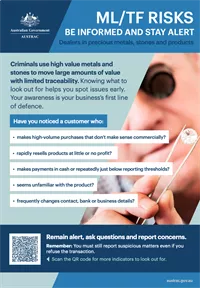 » Updated 16 Jun '26: The following examples outline how transactions may be treated under incoming AML/CTF regulations.
AUSTRAC has published examples of linked transactions for dealers in precious metals, stones and products on its website, which has been summarised below.
Addressing cash sales, instalment payments, supplier arrangements and potentially linked transactions, the following table highlights when purchases may fall below reporting thresholds, when transactions become “linked”, and when retailers should undertake further review or consider alternative payment handling to reduce compliance risk.
While some cases are clear to see where transactions are linked or not linked, others highlight situations where you need to assess whether transactions are connected based on the facts.
In determining whether transactions are linked, consider whether they:
• are connected to the same items
• are connected to the same purchase or sale
• are connected to an ongoing arrangement
• have an underlying purpose (including attempts to structure under the $10,000 threshold).
Examples of Linked Transactions The following show how transactions are commonly linked in the jewellery industry. |
|---|
Example 1 – Instalment arrangement for the same item Your customer buys an item valued at $12,000. They pay a $9,000 deposit in cash. They return the next day and pay the remaining $3,000 in cash. These are linked transactions because both payments relate to the same sale and item. As the combined value of these linked payments is $12,000, you’ll be regulated if you accept both these payments. |
Example 2 – Layby payments for the same item Your customer puts a $15,000 item on layby. They pay a $3,000 deposit, and multiple cash instalments totalling $12,000. These are linked payments as they all relate to the same sale and the same item. Their combined value is $15,000, above the $10,000 threshold for regulation. |
Example 3 – Invoice paid in cash instalments for the same items You’re a supplier and you invoice goods for $12,000. Your retail customer agrees to pay in 3 cash instalments of $4,000 over 3 months. These are linked transactions because they all relate to the same sale and the same items. Their combined value is $12,000, which is above the $10,000 threshold for regulation. Even if payments are spread over time, they remain linked transactions. There is no time limit after which linked transactions reset for threshold purposes. |
Example 4 – Return and exchange with a cash top-up for the same items Your customer buys 2 jewellery items, one for $7,000 and one for $2,000. They pay $9,000 cash for both items. Your customer returns 3 months later to return the $2,000 item. The customer asks to exchange it for a $7,000 item and pay the difference in $5,000 cash. Although it wasn’t initially, this is now a linked transaction. If you accept the difference paid in cash or virtual assets, this becomes a linked transaction. This is because: • the exchange and cash top-up is connected to the original sale and sold items
• when assessed together, the total value of the linked transactions is at or over $10,000. |
Example 5 – Payments for different items made under the same ongoing business arrangement You’re a retail business, and you have an overseas supplier that supplies you precious metals, stones and products. Your supplier delivers jewellery items to you, on the following terms: • you sell the items you purchase from the supplier in your retail store
• each month they will visit you and collect payment in cash for the goods sold to date. Over time, the total cash payments exceed $10,000. “Goods sold to date” means the cumulative value of goods supplied to you under the arrangement. It includes goods already paid for and goods that remain outstanding. These payments are linked, and AML/CTF obligations apply to you because the: • payments are part of a single, ongoing arrangement from with payments for precious metals, stones and products made over an extended period
• purchases are a part of carrying on a business
• payments are made in cash and are valued at or over $10,000 over time. |
Example 6 – Transactions linked to the same structuring purpose Your customer buys a $9,000 gold chain in cash from a staff member. Before leaving, they ask the staff member what their rostered days off are. The same customer returns on a day that the staff member who sold them the chain has a day off. This time they buy an $8,000 gold chain from a different staff member in cash. The second staff member is not aware of the previous sale. This pattern is repeated over the next two days with two other staff members The customer returns each day to purchase products both: - in cash
- under the $10,000 threshold
When reviewing your transaction records, you identify that: - the same customer details are recorded for both purchases
- the transactions occurred on consecutive days
- the purchases involve similar items at similar values
- different staff members processed each sale.
You question the 4 staff members about the transactions. The first staff member tells you that the customer asked about their work roster in conversation. This behaviour indicates deliberate structuring. The customer appears to plan transactions, so they’re processed by different staff members. - This behaviour indicates structuring, and therefore linked transactions, because the customer:
- asks about staff availability before making further purchases
- returns when the first staff member isn’t working, ensuring a different staff member processes the transaction
- uses staff members who are unaware of earlier transactions, reducing the likelihood the transactions will be linked
- makes separate cash transactions for similar purchases, over consecutive days, each below $10,000.
As the linked transactions are valued at $10,000 or more collectively, they would be regulated under the Act. |
Examples of Transactions that are Not Linked The following show situations where transactions aren't linked because they are separate and not connected. |
|---|
Example 1 – Discounted Sale Your customer buys an item valued at $11,000 and you offer a discount to $9,900 for a cash payment. This is a single transaction below $10,000. On its own it’s not a linked transaction. If this pricing approach is repeated with the same customer, it may indicate structuring and should be assessed. |
Example 2 – Same customer returns next day for a similar purchase Your customer buys a $7,000 diamond pendant and gold chain for their daughter, in cash. The next day they return to buy another $7,000 gold chain for their other daughter, in cash. Each transaction is below $10,000 and there is no instalment arrangement or shared invoice. On these facts alone, these aren’t linked transactions because they both: • relate to separate items and sales
• don’t seem to be linked to any broader arrangement. |
Example 3 – Two different customers purchasing the same kind of item Your customer buys a $6,000 diamond ring in cash. The next day a different customer asks to buy the same kind of ring that their friend purchased. They also pay in cash. These are 2 separate customers, with separate transactions. Based on these facts, this isn’t a linked transaction. Even if there are more similar transactions, they’re still not linked, unless something connects them. For example, the same customer returns to purchase the same or a similar item in cash and they’re displaying unusual behaviour to avoid the $10,000 threshold. |
Navigating these reforms isn't optional. It's essential for the jewellery industry's future. Choose your path wisely, train your staff on red flags, and integrate these practices into daily operations.
Navigating these reforms isn't optional. It's essential for the jewellery industry's future. Choose your path wisely, train your staff on red flags, and integrate these practices into daily operations.
For those seeking additional information, the seminar below organised by Australia’s industry buying groups dive into these regulatory reforms.
Remember, this guide provides a broad overview; it's not a substitute for tailored legal or professional advice. Consult experts to align with your specific circumstances and ensure your business thrives in this new regulatory era.
Please check back for updates.
 | William Morris
AUSTRAC | | |
» Click here to download Online Seminar Slides » UPDATED: Click here to download AJF 'The Next Steps' Seminar Slides In this post-seminar recap, we outline the key takeaways from an essential session on regulatory compliance for jewellery businesses. Featuring William Morris, AUSTRAC’s Director of Guidance, the seminar explained how recent government legislation affects AML and CTF requirements and offered practical strategies to stay compliant and avoid penalties. Morris breaks down what AUSTRAC and other regulators expect, highlighted common risk areas in jewellery transactions, and shared actionable steps you can implement right away. What’s covered:
• Overview of the latest AML/CTF changes affecting the jewellery industry
• Real-world examples of compliance pitfalls and how to avoid them
• Practical, low-friction measures to strengthen your AML/CTF controls
• How to prepare for ongoing regulatory updates and audits |
Read eMag
More reading
Law changes: Buying groups unite to support jewellers
How will new money laundering laws impact your jewellery business?
New money laundering laws: Millions at stake in the jewellery industry