The new anti-money laundering and counter-terrorism financing laws come into effect from 1 July. Any jewellery businesses intending to accept or pay $10,000 or more in cash or virtual assets from 1 July 2026 must register with the Australian Transaction Reports and Analysis Centre (AUSTRAC) by that date.
Jeweller's comprehensive guide to these new regulations is available here. This guide was recently updated to include examples of ‘linked transactions’.
AUSTRAC recently published examples of linked transactions for dealers in precious metals, stones and products on its website.
Addressing cash sales, instalment payments, supplier arrangements and potentially linked transactions, the table highlights when purchases may fall below reporting thresholds, when transactions become ‘linked’, and when retailers should undertake further review or consider alternative payment handling to reduce compliance risk.
While some cases are clear about whether transactions are linked or not, others require you to assess whether they are connected based on the facts. In determining whether transactions are linked, consider whether they:
- are connected to the same items
- are connected to the same purchase or sale
- are connected to an ongoing arrangement
- have an underlying purpose (including attempts to structure under the $10,000 threshold).
The Basics
As previously explained, under the new financial reporting requirements, jewellery businesses have four general options available:
- Hard Opt Out: Do not accept or pay any cash or virtual assets for jewellery purchases or sales. This option is unlikely to be practical for many businesses. There is no need to enrol with AUSTRAC if choosing this option.
- Soft Opt Out: Under this option, a business will not accept or pay $10,000 or more in cash or virtual assets. It is recommended, however, that a lower cash threshold be adopted as an in-store policy to reduce the risk of exposure to linked transactions totalling $10,000 or more.
It is recommended that businesses choosing this option adopt a Cash Policy. Businesses choosing this option do not need to enrol with AUSTRAC. - Limited Opt In: This option is for businesses that wish to accept $10,000 or more in cash from low to medium-risk customers, using the “Streamlined Process”.
Businesses wishing to use the Streamlined process must enrol with AUSTRAC. Many jewellery businesses are expected to use the Streamlined Process. The process is intended for businesses that may have up to two or three $10,000+ cash transactions per month. - Full Opt In: Businesses intending to accept cash and/or virtual assets of $10,000 or more for all customer risk types will need to enrol with AUSTRAC and implement an anti-money laundering compliance program.
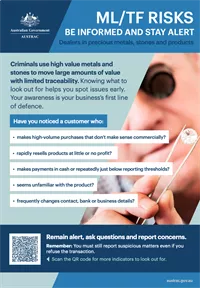 Also released earlier this month, AUSTRAC published examples of linked transactions for dealers in precious metals, stones and products on its website, which has been summarised below.
Addressing cash sales, instalment payments, supplier arrangements and potentially linked transactions, the following table highlights when purchases may fall below reporting thresholds, when transactions become “linked”, and when retailers should undertake further review or consider alternative payment handling to reduce compliance risk.
While some cases are clear to see where transactions are linked or not linked, others highlight situations where you need to assess whether transactions are connected based on the facts.
In determining whether transactions are linked, consider whether they:
• are connected to the same items
• are connected to the same purchase or sale
• are connected to an ongoing arrangement
• have an underlying purpose (including attempts to structure under the $10,000 threshold).
Examples of Linked Transactions The following show how transactions are commonly linked in the jewellery industry. |
|---|
Example 1 – Instalment arrangement for the same item Your customer buys an item valued at $12,000. They pay a $9,000 deposit in cash. They return the next day and pay the remaining $3,000 in cash. These are linked transactions because both payments relate to the same sale and item. As the combined value of these linked payments is $12,000, you’ll be regulated if you accept both these payments. |
Example 2 – Layby payments for the same item Your customer puts a $15,000 item on layby. They pay a $3,000 deposit, and multiple cash instalments totalling $12,000. These are linked payments as they all relate to the same sale and the same item. Their combined value is $15,000, above the $10,000 threshold for regulation. |
Example 3 – Invoice paid in cash instalments for the same items You’re a supplier and you invoice goods for $12,000. Your retail customer agrees to pay in 3 cash instalments of $4,000 over 3 months. These are linked transactions because they all relate to the same sale and the same items. Their combined value is $12,000, which is above the $10,000 threshold for regulation. Even if payments are spread over time, they remain linked transactions. There is no time limit after which linked transactions reset for threshold purposes. |
Example 4 – Return and exchange with a cash top-up for the same items Your customer buys 2 jewellery items, one for $7,000 and one for $2,000. They pay $9,000 cash for both items. Your customer returns 3 months later to return the $2,000 item. The customer asks to exchange it for a $7,000 item and pay the difference in $5,000 cash. Although it wasn’t initially, this is now a linked transaction. If you accept the difference paid in cash or virtual assets, this becomes a linked transaction. This is because: • the exchange and cash top-up is connected to the original sale and sold items
• when assessed together, the total value of the linked transactions is at or over $10,000. |
Example 5 – Payments for different items made under the same ongoing business arrangement You’re a retail business, and you have an overseas supplier that supplies you precious metals, stones and products. Your supplier delivers jewellery items to you, on the following terms: • you sell the items you purchase from the supplier in your retail store
• each month they will visit you and collect payment in cash for the goods sold to date. Over time, the total cash payments exceed $10,000. “Goods sold to date” means the cumulative value of goods supplied to you under the arrangement. It includes goods already paid for and goods that remain outstanding. These payments are linked, and AML/CTF obligations apply to you because the: • payments are part of a single, ongoing arrangement from with payments for precious metals, stones and products made over an extended period
• purchases are a part of carrying on a business
• payments are made in cash and are valued at or over $10,000 over time. |
Example 6 – Transactions linked to the same structuring purpose Your customer buys a $9,000 gold chain in cash from a staff member. Before leaving, they ask the staff member what their rostered days off are. The same customer returns on a day that the staff member who sold them the chain has a day off. This time they buy an $8,000 gold chain from a different staff member in cash. The second staff member is not aware of the previous sale. This pattern is repeated over the next two days with two other staff members The customer returns each day to purchase products both: - in cash
- under the $10,000 threshold
When reviewing your transaction records, you identify that: - the same customer details are recorded for both purchases
- the transactions occurred on consecutive days
- the purchases involve similar items at similar values
- different staff members processed each sale.
You question the 4 staff members about the transactions. The first staff member tells you that the customer asked about their work roster in conversation. This behaviour indicates deliberate structuring. The customer appears to plan transactions, so they’re processed by different staff members. - This behaviour indicates structuring, and therefore linked transactions, because the customer:
- asks about staff availability before making further purchases
- returns when the first staff member isn’t working, ensuring a different staff member processes the transaction
- uses staff members who are unaware of earlier transactions, reducing the likelihood the transactions will be linked
- makes separate cash transactions for similar purchases, over consecutive days, each below $10,000.
As the linked transactions are valued at $10,000 or more collectively, they would be regulated under the Act. |
Examples of Transactions that are Not Linked The following show situations where transactions aren't linked because they are separate and not connected. |
|---|
Example 1 – Discounted Sale Your customer buys an item valued at $11,000 and you offer a discount to $9,900 for a cash payment. This is a single transaction below $10,000. On its own it’s not a linked transaction. If this pricing approach is repeated with the same customer, it may indicate structuring and should be assessed. |
Example 2 – Same customer returns next day for a similar purchase Your customer buys a $7,000 diamond pendant and gold chain for their daughter, in cash. The next day they return to buy another $7,000 gold chain for their other daughter, in cash. Each transaction is below $10,000 and there is no instalment arrangement or shared invoice. On these facts alone, these aren’t linked transactions because they both: • relate to separate items and sales
• don’t seem to be linked to any broader arrangement. |
Example 3 – Two different customers purchasing the same kind of item Your customer buys a $6,000 diamond ring in cash. The next day a different customer asks to buy the same kind of ring that their friend purchased. They also pay in cash. These are 2 separate customers, with separate transactions. Based on these facts, this isn’t a linked transaction. Even if there are more similar transactions, they’re still not linked, unless something connects them. For example, the same customer returns to purchase the same or a similar item in cash and they’re displaying unusual behaviour to avoid the $10,000 threshold. |
In late January, the AUSTRAC issued a nationwide communication to jewellery businesses titled ‘New financial crime laws coming – access our newly released kits to prepare.’
The message introduced a series of jewellery industry ‘Starter Kits’ and supporting AML/CTF guidance documents designed to help businesses understand their upcoming obligations.
More reading
» Guide to navigating AML/CTF law changes: Everything jewellers must know
Money laundering regulations: Deadline approaching for jewellery business
Retail Edge announces major update to jeweller software
Jewellery retailer fined for failing to meet anti-money laundering requirements
The Next Step: Buying groups to host important AML/CTF seminar at Adelaide Fair
 | 2026 JEWELLERS' SUPPLIERS DIRECTORY
Find Anything & Everything Click for the Full Index to discover fresh products, trends, and suppliers.
If it’s not listed here, it’s not worth knowing about! The annual Suppliers Directory is the #1 directory for retailers looking for new products and new suppliers. If you don’t know, we do!
|