LOWEST EBB - KEY POINTS • Rock Bottom
Under its current leadership, the JAA has consistently been unable to attract a range of 'industry people' to its board. It has now reached a new low in its inability to claim to be a genuinely representative association for the Australian jewellery industry.
• Rich & Resourceful
The proof of the pudding is in the eating: the Australian jewellery industry continues to prove that it’s filled with people willing to volunteer their time and energy for the betterment of the trade. • Bigger & Better
Having announced a change to its constitution, an opportunity for a fresh start has opened, which provides a chance for the JAA to be reset with the aim of becoming better than it has ever been. This time around, will the opportunity be grasped? |
For many years, the JAA has been unable to legitimately claim that it “works nationally to represent and protect the interests of the jewellery industry and its consumers”; indeed, it even ceased describing itself as the ‘peak industry body’ some years ago.
In recent months, it seems to have hit a new low.
There are many reasons for this; however, the most recent indication is that the current board has only been able to attract three ‘industry people’ – all of whom are independent retailers.
This is merely the tip of the iceberg because the JAA has also become decreasingly transparent, alienated the buying groups, continues to lose important members, and its financial affairs are under increasing scrutiny.
That’s the bad news. Here’s the good news - all hope is not yet lost.
The JAA may well be ‘saved’ because of an unexpected change to its constitution, which might present an opportunity to restore its reputation within the broader trade, and additionally, once again establish itself as a body genuinely representing and acting in the best interests of the entire Australian jewellery industry.
Before outlining the circumstances of this extraordinary opportunity to ‘reset’ the JAA by ridding itself of the continuing petty politics and misguided decisions that have beset the association, it should be noted that, poetically, it has arrived exactly 10 years after the JAA suffered its self-inflicted ‘fall from grace’.
A decade on, the question is whether this opportunity will be grasped or missed.
One step forward, two steps back
The JAA started 2026 with some positive momentum. It had increased its board to seven members and appointed a new co-opted independent director in late December. It was also moving towards a new chapter in its relationship with the broader industry by participating in the Australian Jewellery Fair in Adelaide.
It would be the JAA’s first appearance at a jewellery fair run by Expertise Events since it ended its 25-year agreement in 2016, when it walked away from the financial sponsorship provided by the International Jewellery Fair.
As the New Year began, the board comprised five retailers, one retiree, and one co-opted director, who was selected for specific corporate expertise.
Admittedly, this board composition remained distinctly unrepresentative of the broader jewellery industry, as the JAA lacked a director representing suppliers, wholesalers, manufacturers, chain stores, or buying groups.
This effectively meant that the entirety of the Australian jewellery industry was being ‘represented’ by five independent retailers and two people who did not actively work in the trade.
With that said, at least it was seven people willing to volunteer their time and energy to the cause.
Indeed, the board expansion and intended participation at the Australian Jewellery Fair marked an optimistic start to the year following a controversial 2025. Unfortunately, the JAA’s affairs quickly turned sour.
Three directors have resigned in the past two months, with one quitting the association over perceived issues with the board’s governance and culture. Worse, in the lead-up to the AGM, held on 30 March, the JAA was unable to replace three departing directors with other individuals from ‘within’ the industry.
In a crushing blow to the JAA, Queensland-based retailer Jay Bartlett quit as director and, in early February, told Jeweller that his “perspective on certain priorities and the direction forward was not fully aligned with that of the Board”.
Despite joining the board with admirable ambitions, he lasted just 10 months in the role. Bartlett even went so far as to withdraw his business from the association after 20 years as a member.
This resignation was followed by the departures of Stephen Schneider, a Victoria-based retailer, and Mary Storch, a retiree who had not worked in the industry for 20 years.
Turning inside out
The board was therefore reduced from seven to four following the resignations of Bartlett, Schneider and Storch, which meant that the JAA president, Joshua Sharp, and vice president, Ronnie Bauer, were responsible for rebalancing the board with a more appropriate and, more importantly, representative composition of industry members.
Sharp and Bauer both operate retail stores, as does treasurer Daniel Anania, while newly appointed co-opted director Lindsay Kotzman is a lawyer with governance and compliance expertise.
Based on the outcome of the AGM, it seems apparent that the team of Sharp, Bauer, Anania, and Kotzman was unable to secure replacements for the three departed directors with other ‘industry people’ – whether they be suppliers, manufacturers, or even additional retailers.
Instead, a second co-opted director, external to the jewellery industry, was appointed, once again on the basis of their governance and regulatory expertise.
Sharp announced that Anna Hakman would join the board, explaining that she “brings deep expertise in governance, strategic planning and stakeholder engagement. She is a trusted advisor to boards and executive leadership teams.”
Where is everyone?
For members, it’s worth questioning why Sharp and Bauer felt compelled to appoint a second co-opted director, particularly given the staggering lack of representation from other industry sectors.
When Kotzman’s appointment was announced just three months ago, Sharp explained that he, too, was a governance expert: “Lindsay brings deep expertise in governance, regulatory matters and strategic risk, which will be a valuable addition to the Board as the JAA continues to navigate a complex and evolving industry environment.”
The outcome of the recent AGM means that 40 per cent of the board now comprises ‘non-industry’ people. Said another way, there are two governance and regulatory experts providing advice for just three industry-associated people, all of whom are independent jewellery retailers.
There was a time in the 2000s when the JAA had no problem attracting suitably qualified people to its board. At one point, the JAA board consisted of 14 people from all corners of the industry.
Currently, it can only manage three, all of whom share the same background with small jewellery stores.
While it is desirable for a member-based association to include external (non-industry) people on a board to provide specialised and independent advice and expertise, the JAA’s past management of the co-opted director position has not passed the ‘pub test’.
One need only consider the controversy surrounding the tenure of Meredith Doig, beginning in 2022, to understand how her position and appointment were mishandled.
As it concerns the appointment of Hakman, there are other important questions to consider, given that the board now consists of two people outside the industry.
For example, does Hakman bring specific governance and regulatory expertise to the JAA board that Kotzman, the other co-opted director, lacks?
If the answer to that question is ‘yes’, then what specific expertise is it? And more importantly, what are the implications of Sharp’s affirmation for the appointment of Kotzman in December?
The far more likely answer to that question is ‘no’, which raises another question: Why have a ‘double up’ of co-opted directors on a small board such as that of the JAA?
Surely, the board's more appropriate priority should be recruiting directors from the pool of manufacturers, suppliers, buying groups, and/or chain stores, rather than doubling down on its governance resources.
Where have you been?
As part of the announcement of Hakman as director, the JAA described the jewellery trade as a “complex and evolving industry environment.”
While this may be true, based on some of the ‘biggest’ stories of the past year, it must be asked what value two co-opted directors will be in “navigating” this environment.
Sour at the start,
Bitter in the middleThe past four years have been consistently tumultuous for the JAA board. Jo Tory stepped aside as president in November 2021, and Karen Denaro stepped forward to take the reins. However, she lasted only 10 months in the position; Denaro suddenly quit the board in October 2022, citing “misguided management decisions”. At the same time, Denaro also resigned her business’s membership to the JAA. As vice president, Joshua Sharp assumed the president’s position while Ronnie Bauer was appointed vice president at the same time. One month later, Bauer, the newly appointed vice-president, was apologising for and retracting comments he had made, admitting he had no first-hand knowledge of the subject on which he had made false claims. As the timeline below demonstrates, these were the first of many issues the JAA would face between 2022 and 2026. » November 2022
JAA vice president retracts comments and apologises » December 2022
Questions about directors' undisclosed relationship » December 2023
Queries over governance standards; possible breach of regulations » January 2024
JAA faces more governance regulatory issues » February 2024
Major jewellery chain quits JAA » September 2024
JAA false claims over ‘outlets’ » March 2025
JAA loses long-term supporter over membership confusion » November 2025
Former JAA directors criticise the association » February 2026
JAA corrects internal accounting errors? » February 2026
JAA’s requests correction and exposes internal issues » February 2026
JAA director confirms shock resignation » April 2026
JAA makes false claims » April 2026
New 'governance director' stays silent on false claims |
Recent history suggests none, given that many of the problems faced by the JAA are consistently self-inflicted.
Consider these few examples concerning the JAA’s relationship with the broader industry:
» Jewellery Apprentices: In the space of one year, the industry’s three buying groups - Nationwide Jewellers, Showcase Jewellers, and the Independent Jewellers Collective - successfully lobbied for improved government support for jewellery apprentices.
The JAA’s only relationship to this significant change was to appear to claim credit for the success by publishing a media statement on its website, while failing to acknowledge the buying groups whatsoever.
When Jeweller confronted the JAA with the widespread disdain for its handling of this matter, the association was given something rare - a second chance.
Despite having done nothing to improve the situation with jewellery apprentices, the buying groups proactively attempted to include the JAA in their campaign. The reward? Nothing.
» New AML/CTF legislation: Similar criticism has been levelled at the JAA for its lack of work around the upcoming implementation of anti-money laundering (AML) and counter-terrorism financing (CTF) legislation, and its impact on the jewellery industry.
Once again, the three buying groups have collaborated to host multiple educational seminars for retailers and suppliers to ensure that as many members of the industry as possible are informed of what must be done, as falling on the wrong side of the law can be disastrous for business owners.
Given that this affects the entire trade, what has the JAA done? Nothing. The important online AML/CTF seminar attracted more than 100 participants, none of whom were JAA directors or staff.
Indeed, an early morning seminar at the recent Adelaide Jewellery Fair attracted around 50 participants. Jeweller is unaware of any educational events conducted by the JAA for its members.
» Ghost Stores: Over the past year, the issue of ‘ghost stores’ has generated national newspaper headlines and been covered extensively on television. Many of the scams have involved fake jewellery stores. Both Jeweller and the mainstream media have reported extensively on this issue.
Privately, members have expressed immense disappointment with the organisation’s failure to provide, at the very least, public guidance to members who may find themselves targeted by fraudsters willing to steal digital content from genuine jewellers as part of their scams.
» Supplier Sub Committee: The same failures are evident in the recent ‘Supplier Sub Committee’ saga. In a bid to “better represent and respond to the evolving needs of Australian suppliers”, the JAA instead did more harm than good.
In some regards, the JAA’s failure with the Supplier Sub Committee boiled down to asking the right question and being upset when hearing the answer.
The JAA attempted to establish a committee to investigate supplier dissatisfaction with what it called the ‘duplication’ (read: ‘double expense’) of trade shows running in Sydney – the International Jewellery Fair (Expertise Events) and Jewellery Industry Fair (Jewellery Industry Network).
The unfortunate outcome was self-inflicted. It seemed entirely lost on the JAA that supplier frustrations continue to be driven, in large part, by the JAA’s support for - and endorsement of - the smaller show (Jewellery Industry Fair) and its complete lack of participation in the larger show (International Jewellery Fair).
Said another way, the JAA was attempting to lead an investigation into a problem for which it was, in no small part, responsible. No wonder the outcome was seen as a trainwreck.
As recently as this week at the Australian Jewellery Fair, industry leaders and observers noted that the JAA had blown another opportunity to restore its image. This will be detailed in Part II next week.
While the JAA claims it is attempting to “navigate a complex and evolving industry environment”, it has continually failed to achieve what should be its primary objective – constructing a board that truly represents all sectors of the jewellery industry.
Today, the JAA has as many staff (three) as it does industry board members (three), and, as noted, it was a little more than a decade ago that the JAA board managed to attract 14 directors from every corner of the trade.
Small change, big opportunity
With that said, there was a silver lining in the recent AGM announcement to members - all is not lost.
With little fanfare, the JAA also declared: “Members approved a constitutional amendment relating to Board leadership tenure. Under the revised Constitution, the roles of President and Vice President will be limited to a maximum of four years in each position.”
This represents an opportunity to reset the JAA – not into something resembling the organisation before 2016, but into something better than it has ever been.
A complete rethink is required, one that removes the possibility of petty politics affecting the entire industry.
It’s arguable that the JAA board did not learn from an observation made by Jeweller many years ago:
- The Australian jewellery industry will survive without the JAA, but the JAA cannot survive without the Australian jewellery industry.
Sharp joined the board in February 2021 and was appointed president in October 2022. Bauer was appointed vice president in October 2022, at the same time as Sharp became president. This current position is Bauer’s second stint - he joined the JAA board in 2011.
According to the JAA’s constitutional amendment, this means that Sharp and Bauer’s terms as president and vice president will end in October of this year; they must step down.
It must be said that under Sharp and Bauer, the JAA has experienced a period of consistent controversy and drama. (See breakout box above)
Breaking news ...
As mentioned above, the JAA started 2026 on a positive note with a seven-member board, and, after 10 years in the wilderness, had confirmed it would exhibit at the Australian Jewellery Fair in Adelaide.
These were early signs of a possible rekindling of its relationship with Expertise Events.
What is not widely known at the time is that the deal was negotiated by Jay Bartlett and Stephen Schneider, the newly appointed directors, and that it was done on the strict and unconditional basis that Sharp was not part of the discussions.
Documents obtained by Jeweller show that Sharp was outright excluded from these negotiations, reflecting the bitterness of the fallout and failure of the JAA’s Supplier Sub Committee.
That was in late October last year, and now, only four months later, both Bartlett and Schneider have quit the board. Bartlett also went so far as to resign his store’s JAA membership, lending further credence to the view that the JAA is at its lowest point in history.
And as if the board's recent misleading or false claims about its financial position are not bad enough, Jeweller has learned of more issues surrounding the board that are not widely known and have not been reported. These will also be detailed in a follow-up article.
Fool me once…
On one hand, the constitutional requirement for Sharp and Bauer to step down from the ‘leadership’ positions raises significant concerns about continuity for the JAA.
As it stands now, the pair’s departure in about five months’ time would leave the JAA with only one ‘industry person’: retailer Daniel Anania, who joined in January 2023. Aditionally there would be two ‘external people’: Lindsay Kotzman, who joined in December 2025, and the recently appointed Anna Hakman (April 2026).
On the other hand, it’s an ideal opportunity for the JAA to start anew with a clean slate – a chance the JAA missed entirely the last time it faced a significant crisis.
That is, in 2016, when the JAA made the catastrophic attempt to launch its own jewellery trade show, the three people responsible for the venture - Selwyn Brandt, Laura Moore, and Amanda Trotman [nee Hunter] - each left the association. It was the beginning of its fall from grace to where, today, it has perhaps reached its low ebb.
Following their departure, it was clear that the JAA required a dramatic restructuring to ensure lessons were learned in the wake of the disaster. Instead, it essentially persisted with a ‘skeleton crew’ of people who were, presumably, in support of the decisions that led to the crash.
It is therefore no coincidence that in 2020, the JAA then chose to closely align itself with Laura Moore’s subsequent ventures – supporting the launch and endorsing a second jewellery industry fair in Sydney.
Six years later, the JAA attempted to launch a committee to investigate the problems caused by the clashing trade shows – the very same environment that it had spent 10 years fostering.
Said another way, the JAA board's endorsement of a second 'rival' jewellery fair, created by former vice president Laura Moore, led to a split in the industry.
Several years later, this ongoing split prompted current president Joshua Sharp to create a Supplier Sub Committee to investigate the issues this division was causing for suppliers.
After reports emerged of the disharmony caused by the Supplier Sub Committee, the JAA responded by issuing a media statement, which opened an entirely new 'can of worms' because it included false claims about its financial affairs.
Every step of the way, this chain of controversy can be traced back to petty politics and the JAA's decision to endorse the creation of a second jewellery fair - or, at the very least, to support one event, and not the other.
The JAA’s Great Reset
The constitutionally mandated requirement for Sharp and Bauer to step down could open the door for the JAA to reset.
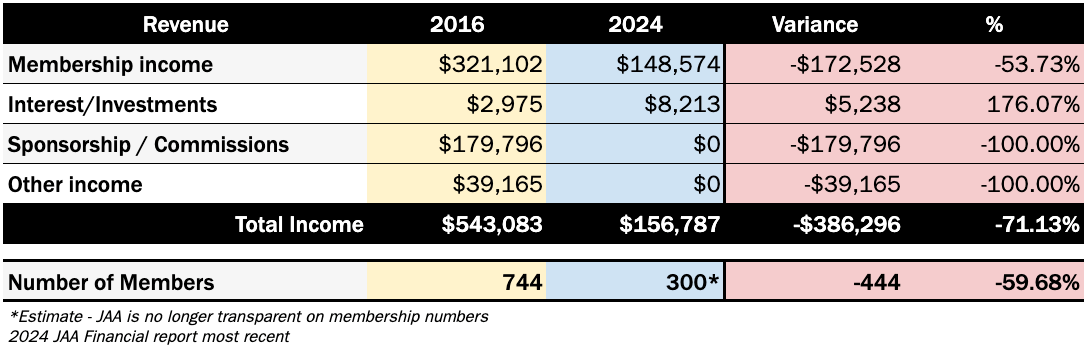
The JAA has struggled for many years to introduce non-retailers to the board, and some industry pundits think that resurrecting the JAA is a task too tall to consider and, as the 2024 financial information above indicates, the JAA's decline continues.
Some believe that the ‘brand damage’ the JAA has endured is insurmountable; they could be right.
To illustrate the sheer pettiness surrounding the JAA, one only needs to consider the subsequent furore sparked by two former JAA directors - Karen Lindley and Ian Brookes - who took to social media to vent and criticise Bartlett and Schneider's attempt to unite the industry.
However, there is every reason to believe the Australian jewellery industry is filled with people willing to lend their time and expertise to the JAA.
Jay Bartlett joined the JAA last year with admirable ambitions. Among them was the hope to secure a place for the JAA to return to the Australian Jewellery Fair in Adelaide, the first time in a decade it would appear at a trade show operated by Expertise Events.
Bartlett, however, felt compelled to resign as a director after just 10 months – citing significant cultural and governance issues as his primary concern. Stephen Schneider, who helped lead the negotiations with Expertise Events, has also resigned from the JAA after just one year.
The same can be said of the JAA’s catastrophic attempt to launch a Supplier Sub-Committee. While the JAA’s management issues led to the project's quiet abandonment, a number of suppliers at least agreed to join the committee when the JAA proposed it. Suppliers volunteered their time.
Another factor worth highlighting is the remarkable efforts of Australia’s three buying groups, collaborating to lobby government departments to increase support for apprentices and ‘spread the word’ about important changes to financial reporting requirements.
What should be noted here is that the three groups are, effectively, 'competitors', and yet were willing to collaborate to achieve something the JAA could not.
These successful campaigns have demonstrated two things: firstly, that a single, united voice for the jewellery industry can achieve meaningful change, even if the change was not achieved by a representative association.
Secondly, the jewellery industry remains full of people willing to volunteer their time and effort for the betterment of the broader trade, not to enrich themselves but to secure a sustainable future for the industry.
The JAA’s Great Reset is possible. Jeweller believes the right people exist, and they will step forward under the right circumstances.
On that basis, Part II will detail what needs to be done to put the ongoing petty politics to rest once and for all, and to re-establish the JAA as a credible representative body - not what it once was, but something better than it has ever been before.
Indeed, the lowest ebb often signifies a turning of the tide.
 | 2026 JEWELLERS' SUPPLIERS DIRECTORY
Find Anything & Everything Click for the Full Index to discover fresh products, trends, and suppliers.
If it’s not listed here, it’s not worth knowing about! The annual Suppliers Directory is the #1 directory for retailers looking for new products and new suppliers. If you don’t know, we do!
|