The pearl industry has always been at the mercy of nature, but the scale of challenges the industry has faced over recent years, and the creativity of the responses, make for a compelling story of adaptation.
After years in the fashion wilderness, pearls staged a dramatic comeback in the 2010s, driven by fresh design approaches that shattered the gem’s stuffy reputation.
Baroque pearls - irregular, organic, gloriously imperfect - became the shape of the moment, embraced by designers from Alexander McQueen to Dolce & Gabbana, and by younger consumers hungry for authenticity over uniformity.
Multi-coloured strands, mismatched earrings, and pearls combined with gemstones and metals signalled a category reinventing itself with real energy.
Yet beneath the surface, supply-side pressures were mounting. According to a 2019 report, global pearl production had plummeted 60 per cent over the preceding decade, driven by environmental degradation, disease outbreaks, and unsustainable farming practices.
Around the same time, 20 million Akoya oysters in Japan died suddenly, the worst mass die-off in over two decades. In China, government crackdowns on water pollution forced widespread farm closures, while the overuse of post-harvest treatments like maeshori left many pearls with compromised nacre quality.
The broader picture was one of an industry at a crossroads: consumer demand is strong and diversifying, but the biological and environmental realities of pearl cultivation impose constraints that no amount of marketing can overcome.
The sector’s future depended on whether it could balance commercial ambition with genuine sustainability.
The pandemic arrives
The pearl industry straddles the intersection of nature and commerce, but rarely have the pressures from both sides been so acute — or so simultaneous.
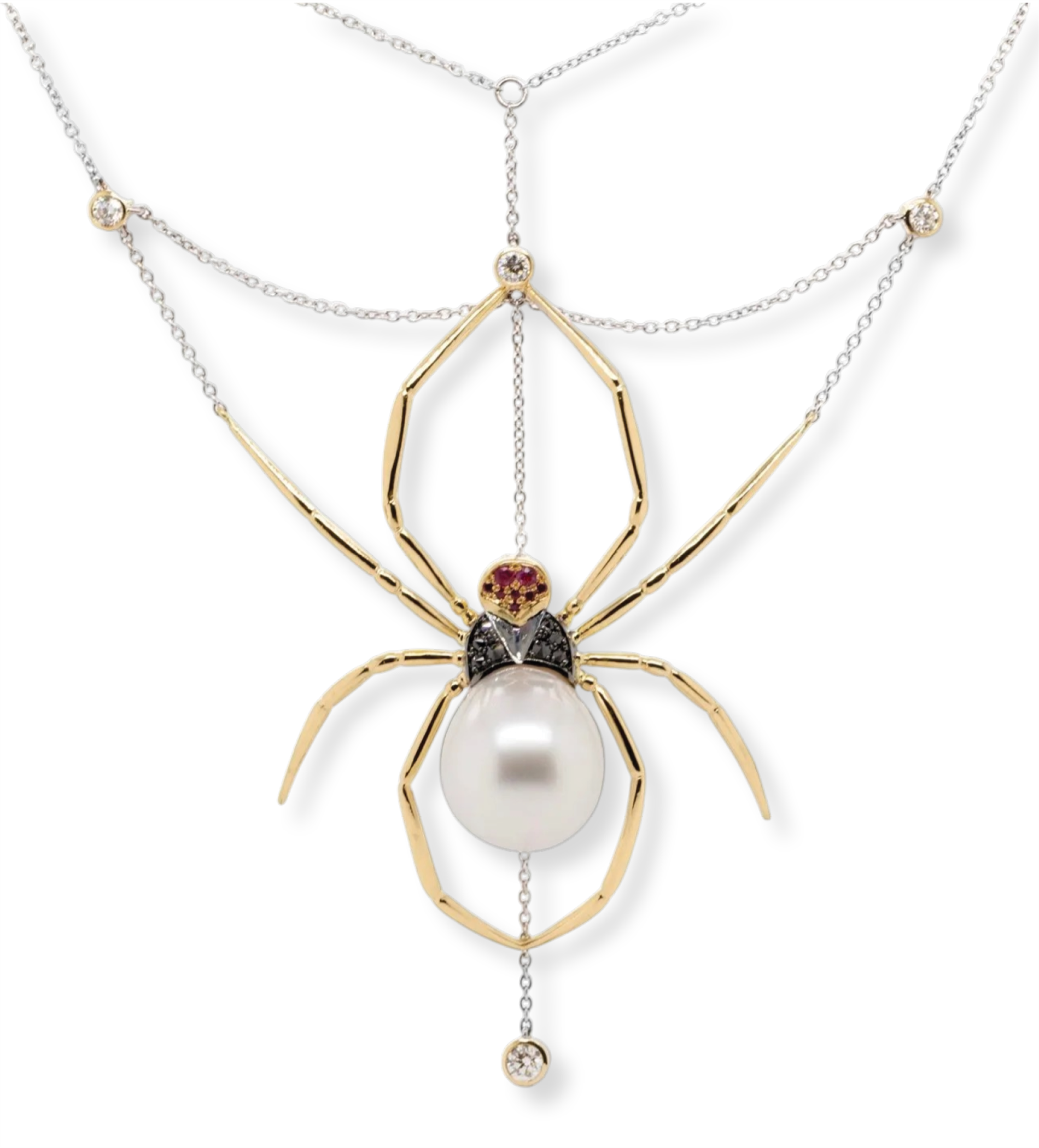 |
| Soklich & Co. |
As the industry was creating new markets and searching for the business models that will carry it forward along came COVID19 causing disruption, ecological decline, and structural vulnerability.
COVID-19 struck the pearl trade with ferocity. With Hong Kong jewellery fairs cancelled and international borders sealed, producers found themselves unable to move product from remote ocean farms to market.
The deeper concern, however, was biological. Australian pearl production value has plummeted 72 per cent from its peak, ravaged by juvenile oyster mortality syndrome, a still-unidentified condition with mortality rates exceeding 90 per cent.
Ocean acidification, rising sea temperatures, and shifting plankton populations compound the threat. Research from the Australian National University warned that nacre, the very substance that gives pearls their lustre, appeared to be the shell layer most vulnerable to these environmental changes.
During this period, baroque and Edison pearls continued their ascent, while classic white strands and larger stones remained staples.
The question of traceability and sustainability, already a growing consumer expectation in the diamond world, is beginning to press upon an industry that still largely lacks formal certification standards.
The picture that emerged is one of profound fragility married to stubborn resilience.
The pandemic departs
As an industry that has is susceptible to sudden and dramatic change, with everything from diplomacy to disease capable of reshaping the landscape it began to remodel itself as it entered a post-pandemic era.
If the pandemic proved anything about the pearl industry, it’s that resilience runs as deep as the ocean beds where these gems are cultivated. This sweeping, multi-market feature revealed an industry that was forced to reinvent itself almost overnight, and emerged stronger for the ordeal.
In Australia, the logistical chaos was acute and impacted the big ‘players’. Paspaley had to negotiate travel concessions across multiple governments just to keep operations running.
Autore Group watched helplessly as border closures delayed the seeding of more than 100,000 oysters by more than a year, destroying roughly 20 per cent of stock in the process.
Yet necessity bred innovation: online wholesale platforms, virtual auctions, and new distribution channels were built at speed, and the results were remarkable. South Sea pearl prices surged 20 to 40 per cent, and several producers reported their strongest trading years on record.
Meanwhile, the University of Western Australia unveiled PearlBone, research into using mother-of-pearl nacre as synthetic bone substitute, a development with the potential to fundamentally reshape the commercial purpose of pearl farming altogether.
In China, it was government environmental policy rather than the pandemic that proved the more transformative force. Regulations introduced in 2015 continued to shrink overall production, though the quality of freshwater pearls improved as farming practices were modernised.
Japan’s Akoya pearl sector weathered disrupted auctions and restricted buyer attendance, buoyed by voracious Chinese demand and a favourable exchange rate. Across all three markets, the same lesson echoed: digital capability and supply chain agility are no longer optional. The pearl industry entered the pandemic as one of jewellery’s most tradition-bound sectors and exited it retooled, diversified, and better prepared for whatever turbulence lies ahead.
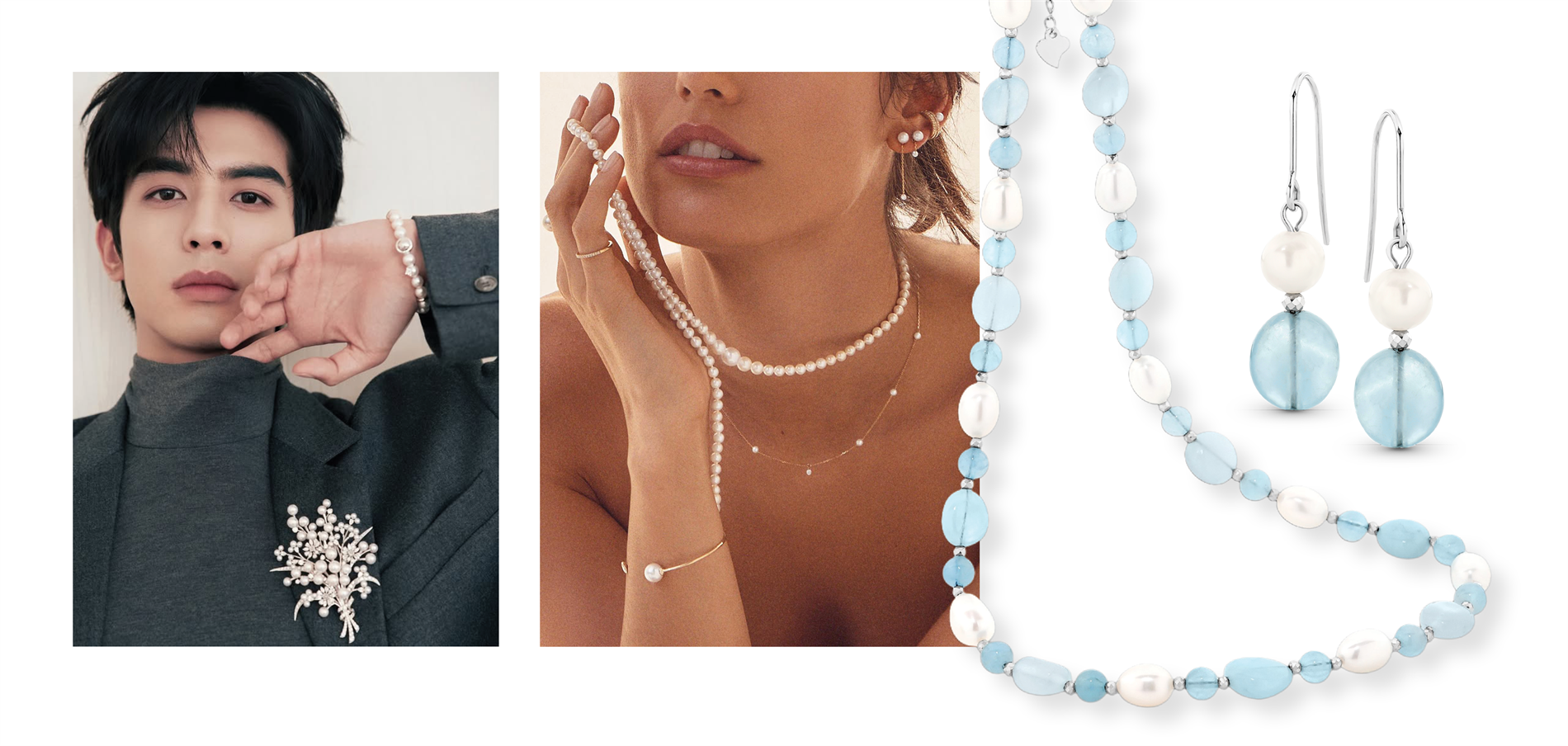 |
| Mikimoto | Mizuki | Ikecho Australia |
Pearls become a man’s best friend
Driven by some of the world’s most recognisable names and faces, a new wave of enthusiasm and market arrived.
It should come as no surprise that a few year after the pandemic men became increasingly attracted to pearls.
The idea that pearls belong exclusively to women is, frankly, a historical anomaly.
Historically, men have been adorning themselves with pearls for millennia, from Julius Caesar, who restricted their wear to the ruling class,
to the Mughal emperors of India and the Qing dynasty’s elaborate court necklaces.
That pearls became coded as feminine is largely a product of 20th-century marketing. What was being witnessed is less a revolution than a correction.
The catalyst for this shift has a name: Harry Styles. Since his pearl earring debut at the 2019 Met Gala, the singer has almost single-handedly dragged pearls into the male fashion mainstream.
He’s been joined by a growing roster of cultural heavyweights — Timothée Chalamet, A$AP Rocky, Pharrell Williams, Jaden Smith — each normalising pearls as a masculine accessory with every red carpet appearance.
Luxury houses including Gucci, Dior, and Mikimoto have responded by expanding their men’s pearl offerings.
Crucially, the data backs the hype. Men’s jewellery purchases surged 150 per cent in 2020, with searches for men’s pearl styles climbing sharply.
A study by MVEye and the Cultured Pearl Association found that 42 per cent of millennials are very likely to request pearl jewellery, and over a third would consider a pearl as an engagement ring centrepiece.
Demand for pearls on the luxury resale market outpaced diamonds in the second half of 2022.
For jewellery retailers, the message is pointed: this market is not a passing celebrity fad. The generational appetite for pearls — gender-neutral, sustainable, and steeped in history — represents a genuine market opportunity that the trade ignores at its peril.
What changed and why?
Once confined to only the most formal occasions, pearl jewellery has become an everyday staple, but why?
For centuries, pearl jewellery occupied an awkward paradox: universally admired, yet rarely worn. Too precious for the everyday, too formal for the casual.
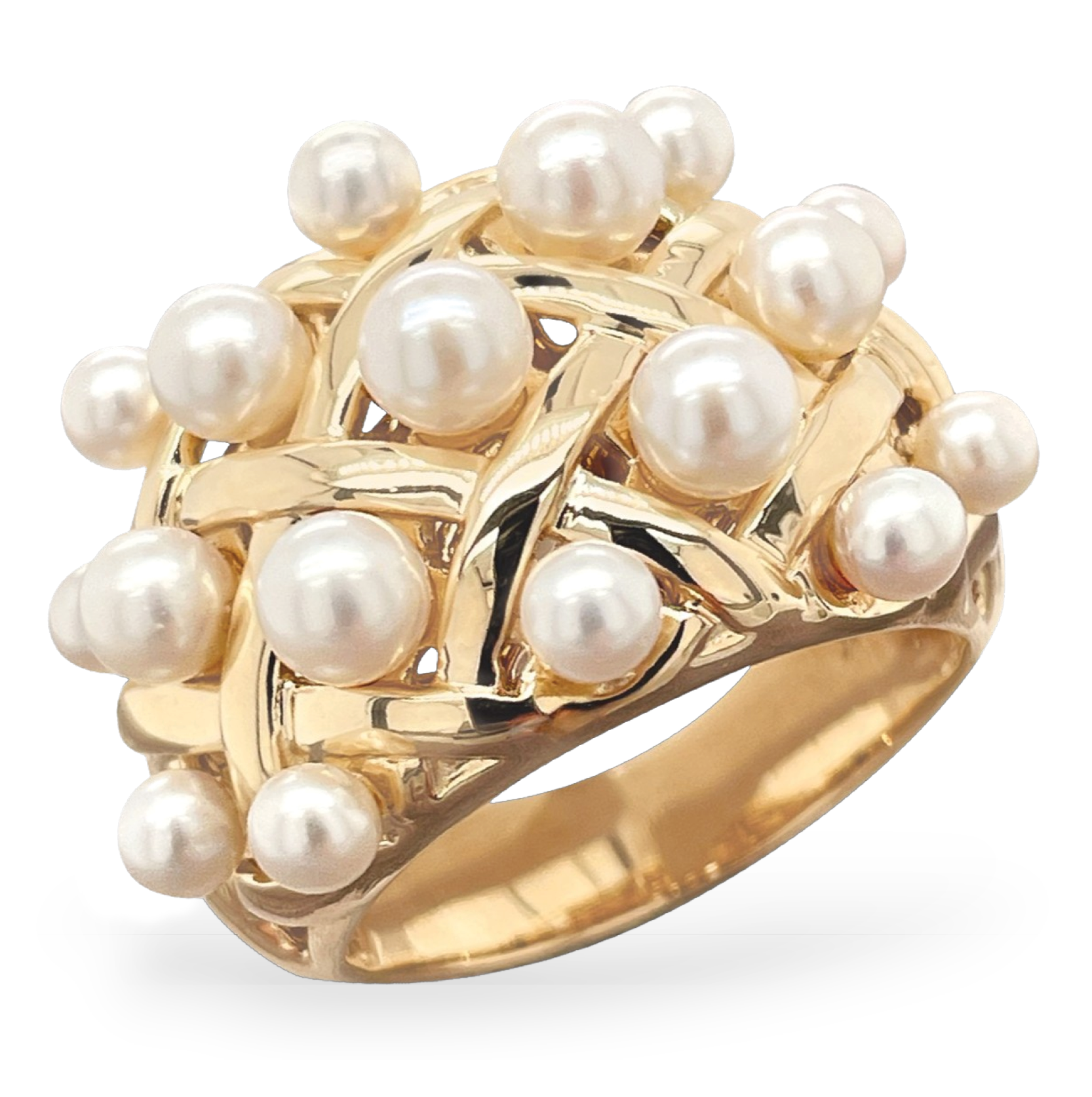 |
| Gerrim International |
Pearls were the gemstone equivalent of fine china, locked away between weddings and funerals.
Those days are over, and the transformation has been driven as much by design innovation as by celebrity influence.
The historical pedigree is beyond dispute. From Cleopatra dissolving a pearl in vinegar to impress Mark Antony, to Anne Boleyn’s legendary rope of natural pearls, to Elizabeth Taylor’s La Peregrina which stunned the auction world by returning USD$11.8 million in 2011.
Indeed, pearls have always signalled power and prestige.
Princess Diana’s Swan Lake Suite, was expected to fetch around USD$15 million before a mystery buyer intervened, only reinforced that association.
What’s changed is accessibility. Today’s designers are juxtaposing pearls with heavy metal chains, stacking thin pearl bracelets alongside gold bangles, and creating pieces that work as comfortably with jeans and a T-shirt as with a ball gown.
The celebrity endorsement runs deep and wide — Rihanna layering archival Dior chokers, Angelina Jolie channelling understated elegance
in Washington, Harry Styles and Timothée Chalamet normalising pearls for men on red carpets worldwide.
Critically, the influence isn’t confined to statement pieces; it extends to everyday adornments that younger consumers are happily borrowing from their mothers’ jewellery boxes.
For retailers, the message is clear: pearls have shed their formality and found a new generation of devoted wearers. The opportunity has never been more open.
Read eMag